Author: Aisling Kelly

  • The autonomy of objects and the power of stories

    Reflections, feeling and the power of crafting a narrative  

    by Yasmin Heyworth  

    What was exceedingly prevalent to me, was as the group began to handle, investigate and manage these objects, as part of the anthropological teaching collection, was the unknown and embedded stories yet to be told. In and of themselves as pieces of autonomy, value and authenticity as well as historically prevalent pieces of ethnographic work.  

    Beginning to fathom the life course of inanimate objects is a perplexing one, as even from an anthropological perspective absolute truths regarding certain unknown objects and artefacts cannot be made. Only educated guesses and intellectual narratives can be proposed.  

    In reflecting on the discipline of anthropology and the effects of colonialism it’s fundamental to question these stories we tell, to not further perpetuate notion of imperial governing. Ethnographic materials are key but often lie in colonial legacies, regarding the ethics of collection and possession. What was evident was a mixture of unease associated with the possession and opportunity to have authority over these pieces of material, but also the privilege in bringing these to light. As proposed eloquently by Hodge (2018), but not proposing the viewer as central to ethnographic material but that the objects contain autonomy in themselves in a step forward as to not extent this imperial gaze.  

    Material culture can often tell stories words cannot. Through a process of ‘listening for the unsaid’ (Hartman, 2008: 2-3) and thus letting these objects speak to us in a sense. But we first must acknowledge that these narratives are politically constituted in guiding areas of speculation in terms of the crafting of stories we were not a part of.  

    I throughly regard transparency to be of the upmost importance and key contributing factor when discussing the upkeep and future narratives of the artefacts we have become entwined with. Acknowledging that we cannot known and can only ever understand one elements in these objects story and our connection and interaction is limited in this sense. Approached to this extent must not be self indulgent. But a genuine interest to share and collaborate allows for further provenance research to commence, giving way to repatriation if this is seen as an appropriate next step.

    Personally, I’ve found this to be a challenging task but altogether enriching, developing my appreciation and thought as regard to museum collections, ethnographic objects and dichotomies with regards to choice, authenticity and opportunity.   

    Further Reading:

    Hartman, S. (2008). ‘Venus in Two Acts’. Small axe : a journal of criticism. 12(2), pp. 1-14. https://doi.org/10.1215/-12-2-1 

    Hodge, C.J. (2018). ‘Decolonizing Collections-Based Learning: Experiential Observation as an interdisciplinary Framework for object study’, Museum Anthropology, 41(2), pp. 142-158. https://doi.org/10.1111/muan.12180 

  • On Provenance Research and Decolonisation 

    On Provenance Research and Decolonisation 

    By Adam Swennen

    Since the life-stories of the objects in our care were so vague when we first started this project, my initial interest went out to provenance research. I was mainly fascinated by the methods used to uncover an object’s story but quickly found out that more than simply filling in gaps, an inquiry into provenance can challenge the colonial legacies embedded in how these objects were collected and curated. 

    At its core, provenance research reveals the journey of an object—from its creation and the context of its early ownership to the ways it was transferred and displayed. This historical insight is crucial not only for establishing ethical narratives around these items but also for questioning the enduring colonial logics that continue to shape modern museology (Tompkins, 2020). By understanding these trajectories, institutions can confront the practices that have long dictated how collections are assembled and interpreted. 

    Yet, the task is complex. Without clear records, we are often left piecing together fragmented evidence, and the uncertainties in an object’s past can obscure its true story. Moreover, there is a delicate balance to maintain. Focusing exclusively on the human history of an object risks sidelining its own intrinsic “voice” and the cultural frameworks from which it emerged. Such an approach can inadvertently reinforce the very colonial mindset we aim to dismantle, by privileging external narratives over the object’s inherent agency. 

    This challenge is compounded by the broader pressures facing museums today. As noted by scholars like Juno Salazar Parreñas (2023), even well-intended efforts to care for and display objects can have unforeseen consequences. Museums must therefore become safe spaces where ideas of care and ethical curation can be explored without the expectation of perfect outcomes. This means accepting that our actions, however informed, are always provisional steps toward a more inclusive and reflexive form of curatorial practice. 

    Ultimately, engaging in thorough provenance research is not simply a scholarly exercise—it is a necessary step toward decolonizing our cultural institutions. By uncovering the full story behind each object, we empower ourselves to challenge and transform the inherited practices of domination. In doing so, we pave the way for a future in which museum collections not only celebrate diversity but also engage in a critical dialogue about the past and its impact on the present (Brulon Soares & Witcomb, 2022; Ticktin, 2023). 

    In this ongoing journey, the quest for truth in provenance is both our tool and our responsibility—a way to honor the multifaceted narratives of our shared heritage while actively working against the colonial legacies that have long defined the museum experience. 

    REFERENCES: 

    Brulon Soares, B. & Witcomb, A. (2022) “Editorial: Towards Decolonisation”. Museum International 74(3-4), iv-xi. 

    Parreñas, J.S. (2023) “Experiment and Excavation in the Ethnographic Museum: Care, Cruelty, and Barbara Harrisson”. In W. Modest & C. Augustat (eds.) Spaces of Care – Confronting Colonial Afterlives in European Ethnographic Museums. Transcript Verlag, Bielefeld: 69-76. 

    Ticktin, M. (2023) ”The Museum as a Space of Radical Imagination: Dismantling and Rebuilding Political Worlds”. In W. Modest & C. Augustat (eds.) Spaces of Care – Confronting Colonial Afterlives in European Ethnographic Museums. Transcript Verlag, Bielefeld: 25-38. 

    Tompkins, A. (2020) “The History, Purpose and Challenges of Provenance Research”. In A. Tompkins (ed.) Provenance Research Today: Principles, Practice, Problems. Lund Humphries, London, England: 15-24. 

  • Thammattama Bera 

    Thammattama Bera 

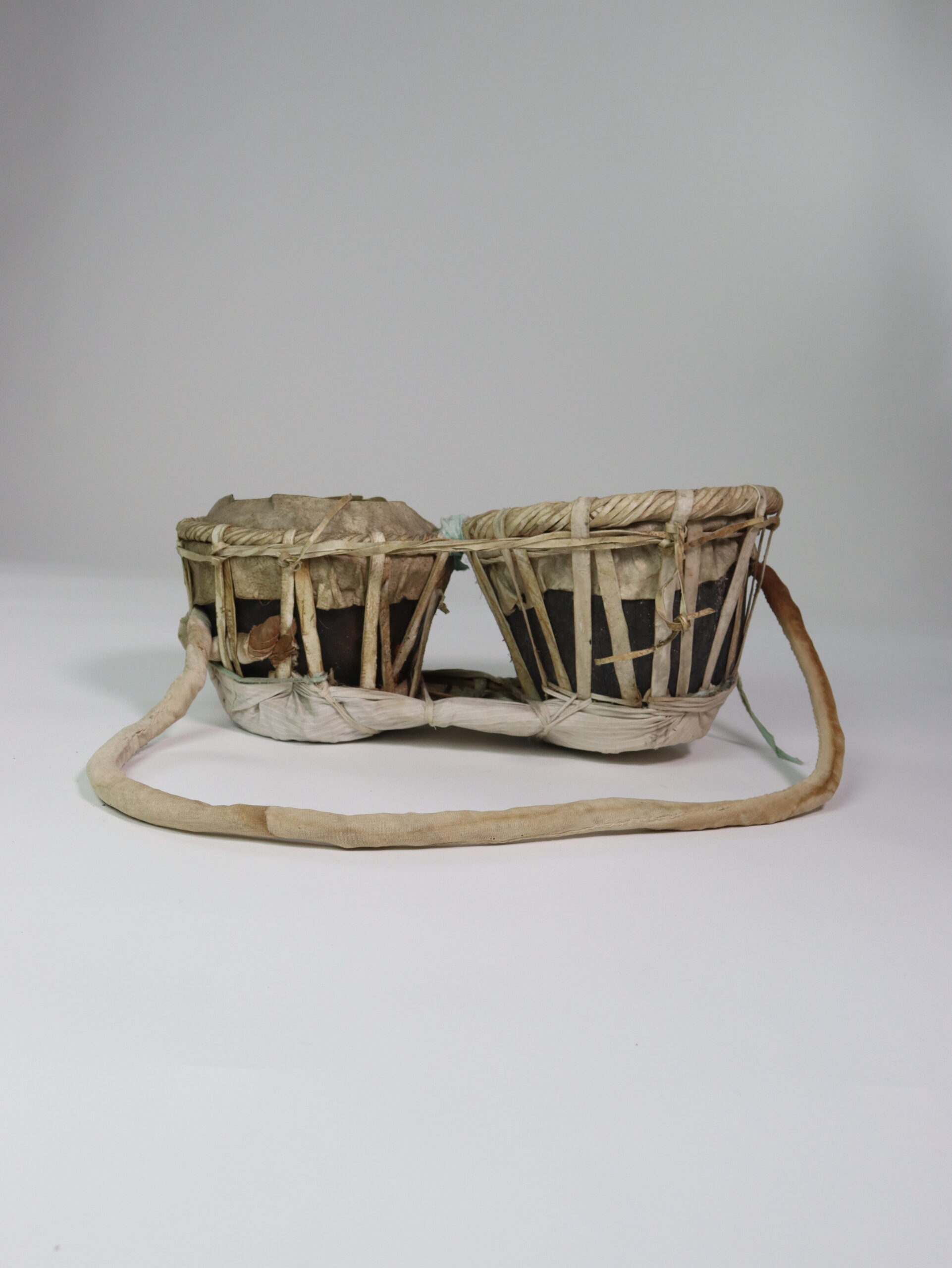
    Title: Thammattama Bera  

    Item Type:  Bongo drums 

    Key Words: Thammattama, bongo drum, drum, Sinhalese, Sri Lanka, musical instrument, Anthony Good 

    Materials:  Wood (possibly from Kohomba, Ehela and Jak trees), animal skin/fibres, cotton 

    Dimensions: 40cm x 20cm


    Description: 

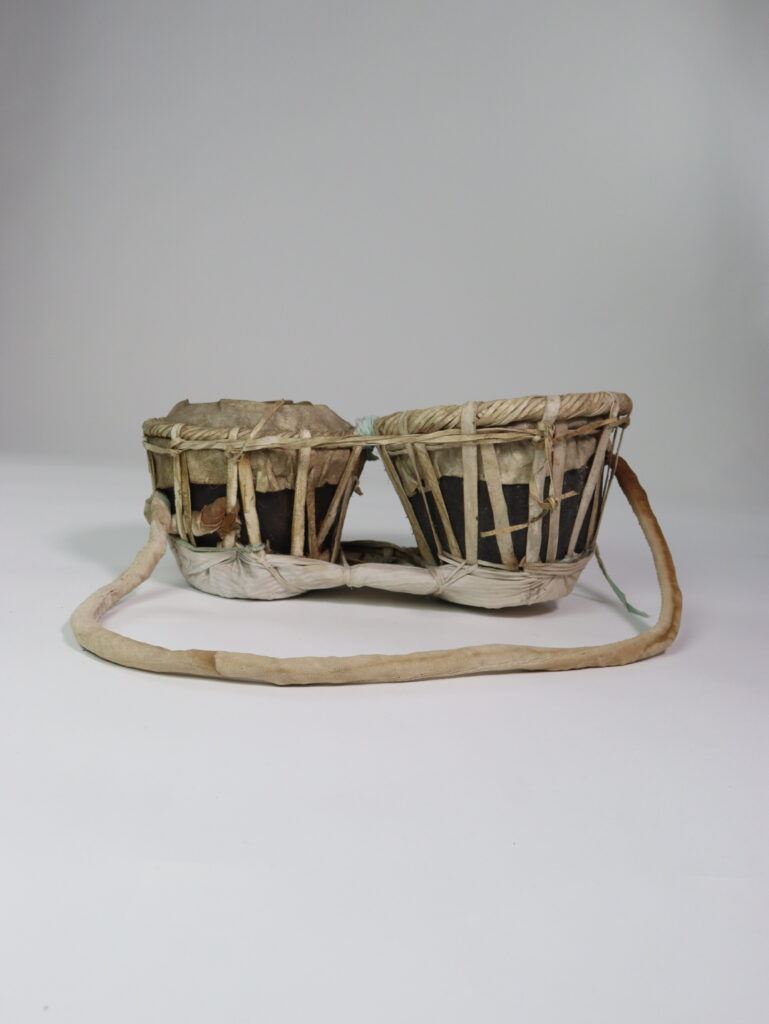
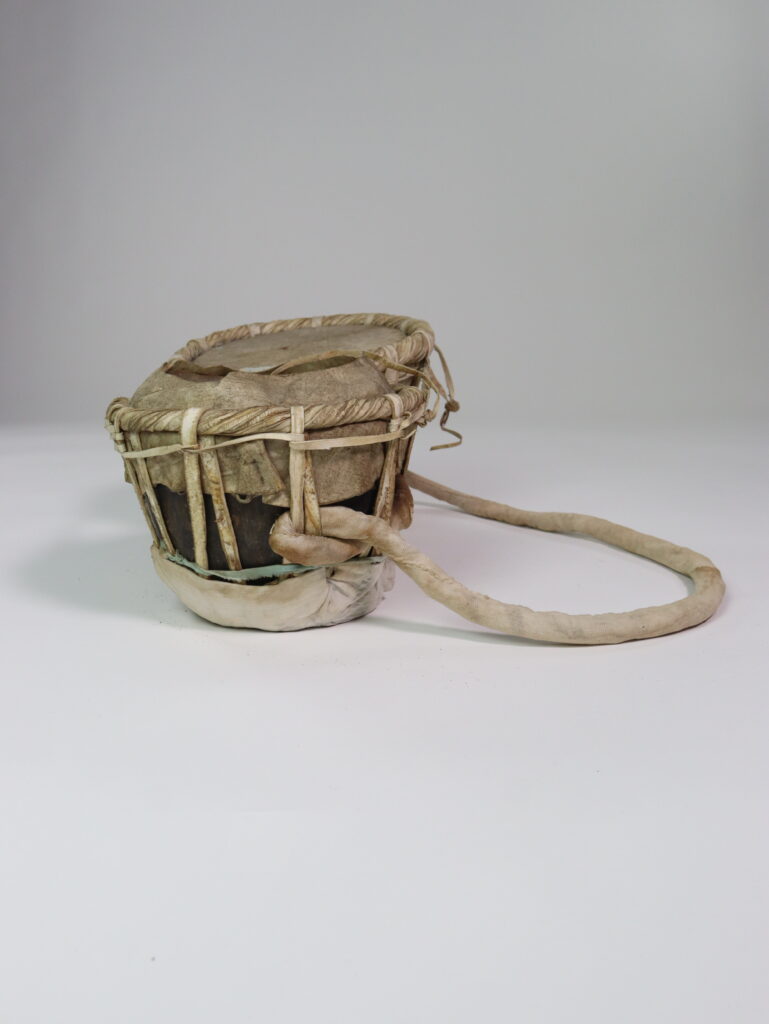
    Bongo drums with a neck strap. The two wooden bowls of the drum are connected by strips of skin and two wooden rods on the sides. The membranes are held by a band of twisted fibres that encase the edge of the drums and are connected to a second fibre on the underside of the drum with ten vertical strips of skin. A thick fibre band (urapota) wrapped in cotton fabric is tied to the skin strips on both outer sides, forming the drum strap.   

    Function:

    The Thammattama Bera consists of two parts, with high sounds produced by the right drum and low sounds produced by the left drum. It is played with two sticks with circular ends rather than with hands. Thammattama is generally not played with equal pressure. There are special rhythms played on this drum used in Buddhist processions, to invite people into the temple, invite Buddhist priests for Pirith ceremonies or for alms giving. In Buddhist processions, the players move in fixed steps to the constantly repeated basic beat of their drums, which is beaten with the left hand, while the right hand adds complicated rhythmic variations. Occasionally, the players use their forearms and elbows as an artistic element in addition to the sticks. In conjunction with the Dawula, the Thammattama fills out the rhythmic cycle set by the cylinder drum.  

    The Thammattama holds significance in Sinhalese society, where, during the times of the Sinhalese kingdoms, Bera were used to announce official decrees and the army marched into battle with war drums (Rana Bera).  

    Production Methods and Techniques:

     It is usual to have a ceremony to begin the production of the Thammatta Bera. However, due to increased commercialisation in regions where these drums are made, it is possible that these ceremonies are ignored.  

    Condition:  

    Fair. There are signs of wear to the bounded fibres and cotton. The two circular bound sticks that are used to play the Bera are missing from the one in our collection.   


    Provenance

    Name of creator: Unknown  

    Where the item was created/made: Unknown, but likely Sri Lanka  

    Date Made: Unknown  

    Acquisition Date: Unknown, but likely pre-1980s.  

    Current Location:  5th floor of Chrystal MacMillan Building on display. 

    Acquisition:

     This object was possibly acquired by Professor Emeritus Anthony Good during his ethnographic fieldwork in Sri Lanka and then donated to the University of Edinburgh’s Anthropology Teaching Collection by him, where the Social Anthropology Department now has ownership. The nature of this acquisition is unknown.  


    Name of Cataloguer:  Ariela Silber  

    Date:  05/03/2025 

    Assession Number: SA035

  • Seed pod rattle

    Seed pod rattle

    Title: Unknown  

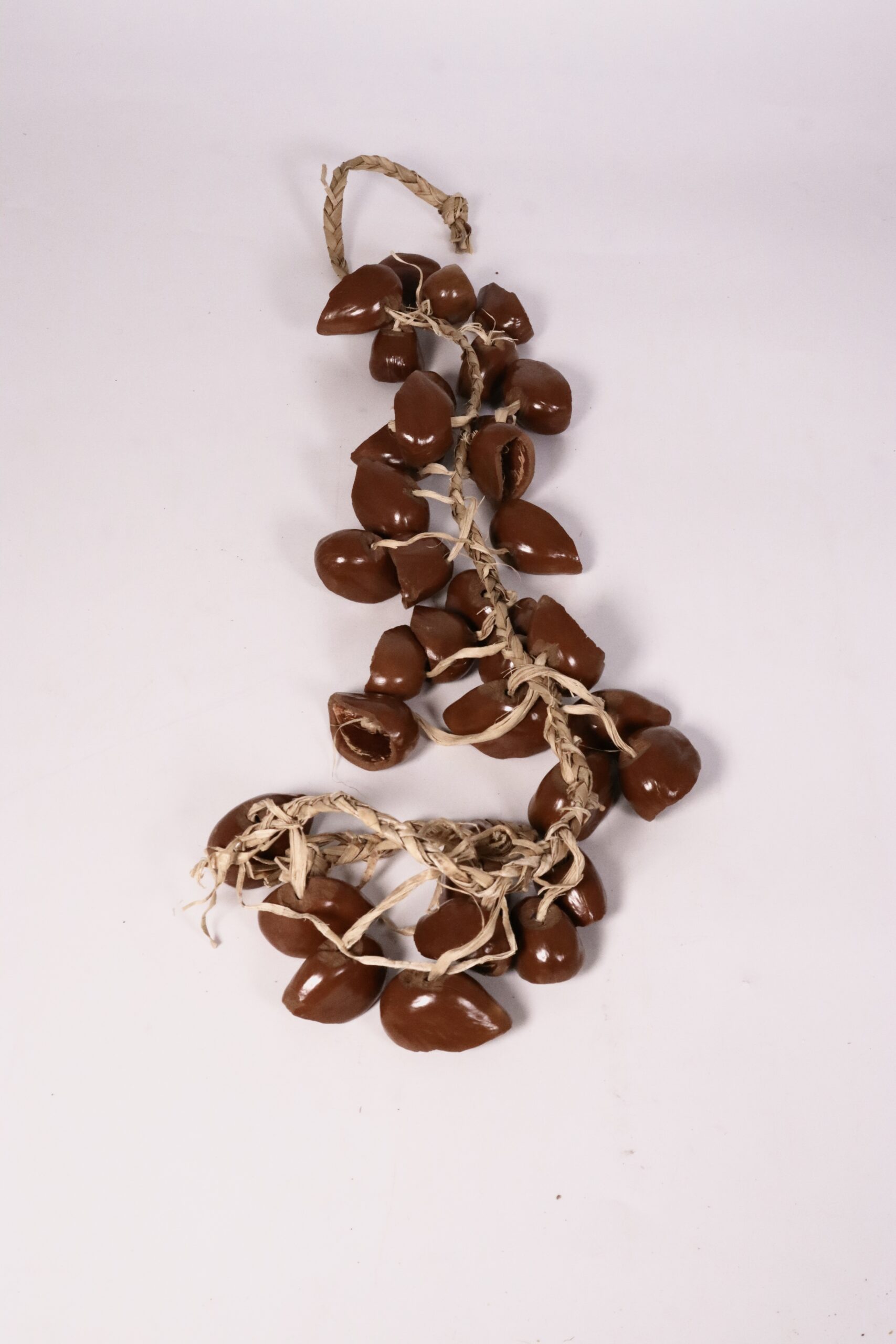
    Item Type: Seed pod rattle  

    Key Words: Rattle, seed pods, musical instrument 

    Descriptions: 

    Long plaited raffia rattle with seed pod cases. The sixteen pairs of seed pods are attached with raffia to the long raffia twine.   

    Function:  Musical instrument  

    Dimensions:  89cm x 2cm 

    Materials:  Seed pods, raffia, twine  

    Production Methods and Techniques: Unknown  

    Condition: Poor/damaged.  


    Provenance  

    Name of Creator:   Unknown 

    Where the item was created/made: Unknown  

    Date made:  Unknown  

    Acquisition:  

    Unknown, but it was likely obtained by a PhD student of a member of staff at the University of Edinburgh during fieldwork and was then donated to the University of Edinburgh’s Social Anthropology Teaching Collection, where the Social Anthropology Department now has ownership. The nature of the acquisition is unknown.   

    Acquisition Date: Unknown, but likely pre-1980s.   

    Current Location:  

    5th floor of Chrystal MacMillan Building on display. 


    General Notes

    Other Associations:

    There is a likely link to object SA014 in the collection, forming a whole rattle.   

    Name of Cataloguer: Astrid Everall  

    Date:  09/03/2025  

    Accession number: SA041

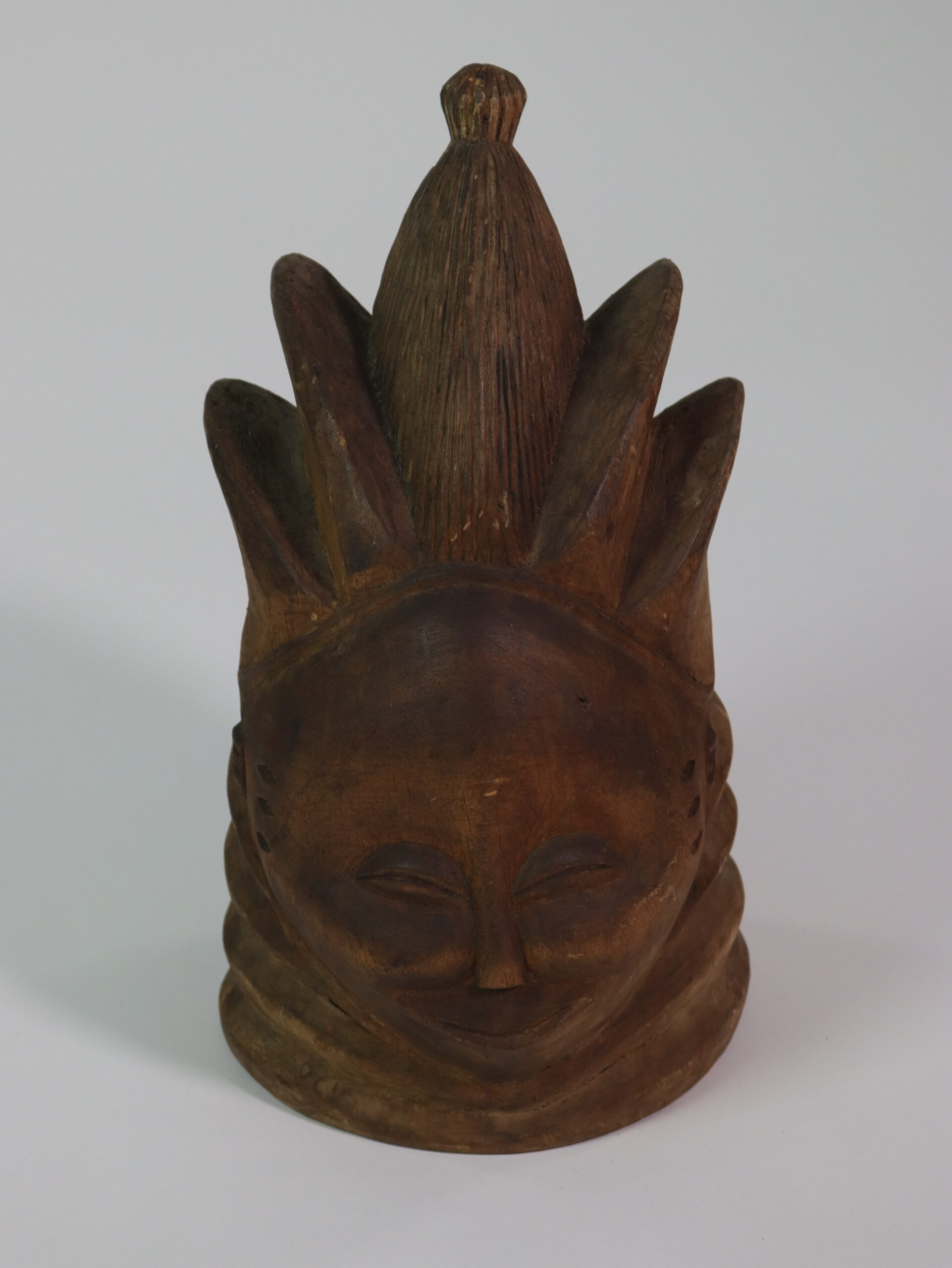
  • Sowei mask 

    Sowei mask 

    Title: Sowei mask  

    Item Type:  helmet mask   

    Key WordsSowei, Bondu, Bundu, Mende, Sande, Sierra Leone, Kenneth Little, mask  

    Dimensions: 46cm x 23cm   

    Materials: Wood and potentially vegetable dye   

    Description:  

    A wooden helmet mask. It possesses neck rings, a detailed coiffure, downcast eyes and a composed facial expression that are typical of the sowei mask. This particular example has a particularly long neck, with ten neck rings. The eyelids are considerably larger than the nose, pursed lips, and ears. There are three scarification marks on each cheek and eight scarification marks on the forehead. The mask has an ornate plaited hairstyle, with three protruding circular parts engraved with a spiral motif, two on each side of the head and one at the back. The mask has two horn-like protrusions between the circular protrusions.

    Function:   

    Sowei masks are attributed to the Sande (also known as Bundu or Bondo), an all-female secret society in Sierra Leone, Liberia, Guinea and the Ivory Coast. The mask is worn during the end of girls’ initiation ceremonies when a ritual dance is performed by the society leader – the ndole jowei (dancing sowei). Usually worn with a raffia costume, the identity of the wearer is entirely concealed. It is believed that the sowei mask represents ideals of feminine beauty, with the full forehead representing wisdom and intellect, and the ringed neck embodying physical beauty in Mende society. This mask is likely a Mende sowei mask from Sierra Leone.

    Production Methods and Techniques:

    Sowei masks are carved from a single piece of wood and hollowed out so it can fit over the wearer’s head. They are dyed with vegetable dye for a darker tint on the mask. Though sowei masks are exclusively worn by women in Mende society, they are carved by men. The carving of a sowei is considered a challenge in Mende society, due to the variance in carving and the special status attributed to the sowei masks. Each carver tends to have their own personal style, where they have the opportunity to demonstrate their artistic skill.   

    Condition:   

    Fair. There is some discolouration and signs of aging on the wood. There is a chip on the left horn.    


    Provenance

    Name of creator:Unknown  

    Where the item was created/made:

    Sierra Leone, but potentially in the Bo District where Kenneth Little was based for much of his fieldwork.   

    Date Made:  

    Unknown, but it is likely to have been made during or prior to the 1940s, when Kenneth Little performed his ethnographic fieldwork in Sierra Leone.   

    Acquisition:   

    We believe that the object was acquired by Professor Kenneth Little during his fieldwork in Sierra Leone. The object was brought to the University of Edinburgh and was donated to the Social Anthropology Teaching Collection. The nature of this acquisition is unknown.  

    Acquisition Date:

    It was likely acquired in 1945 or late 1946 during Kenneth Little’s fieldwork in Sierra Leone. It was likely donated to the Social Anthropology Teaching Collection after Kenneth Little joined the University of Edinburgh in 1950.    

    Current Location: 5th floor of Chrystal MacMillan Building on display.   


    General Notes

    Sowei masks are given a name in Mende society, but we do not know the name of this specific mask.       

    Sources:   

    Little, K. L. (1949). ‘The Role of the Secret Society in Cultural Specialization.’ American Anthropologist, 51, no. 2: 199–212.  

    Otto, Kristin. (2020) ‘Creating the Sowei: Repairing and Interpreting Sowei Masks in Global Assemblages.’ Order No. 28027290, Indiana University.   

    Phillips, R. B. (1979) ‘The Sande Society Masks of the Mende of Sierra Leone.’ PhD diss., School of Oriental and African Studies, University of London.   

    Reinhart, L. (1975) ‘Mende Carvers’. PhD diss., Southern Illinois University Carbondale.  

    Recommended Sites for Further Research:

    Sierra Leone Heritage  

    Name of Cataloguer: Zahra Abdalla   

    Date:  06/03/2025  

    Accession Number: SA030 

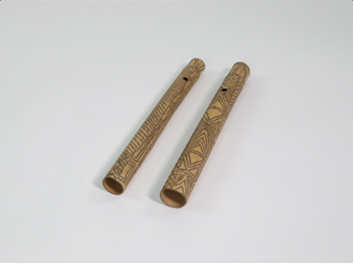
  • Bamboo flutes 

    Bamboo flutes 

    Title:  Unknown 

    Item Type:  Bamboo flutes or tubes 

    Key Words:  Flute, musical instrument, bamboo, Sierra Leone, Bubu 

    Dimensions:   44cm x 4cm  

    Materials: Bamboo 

    Production methods and techniques: Unknown 

    Condition: Good. 


    Description

    A set of two cylindrical, hollow bamboo tubes, closed at one end and open at the other. There are small circular holes at the top of both tubes. The tubes are decorated with detailed carvings of lines, triangles and squares.  

    Function:  

    More research is needed on this object, but it is possible that these cylindrical tubes are musical instruments. There is a potential link to Sierra Leone, and specifically, the village of Mange Bureh, where bamboo cane trumpets are used. These ancient bamboo pipes are played by farmers in the Sierra Leone hinterlands, in the musical style of Bubu.  


    Provenance

    Name of creator: Unknown 

    Where the item was created/made:

    Unknown, but potentially West Africa/Sierra Leone.  

    Date Made: Unknown 

    Acquisition:

    Unknown, but it was likely obtained by a PhD student of a member of staff at the University of Edinburgh during fieldwork and was then donated to the University of Edinburgh’s Social Anthropology Teaching Collection, where the Social Anthropology Department now has ownership.  

    Acquisition date: Unknown, but likely pre-1980s.  


    General Notes

    Name of Cataloguer: Yasmin Heyworth  

    Date:  05/03/2025 

    Accession Number: SA 033.1 – 33.2

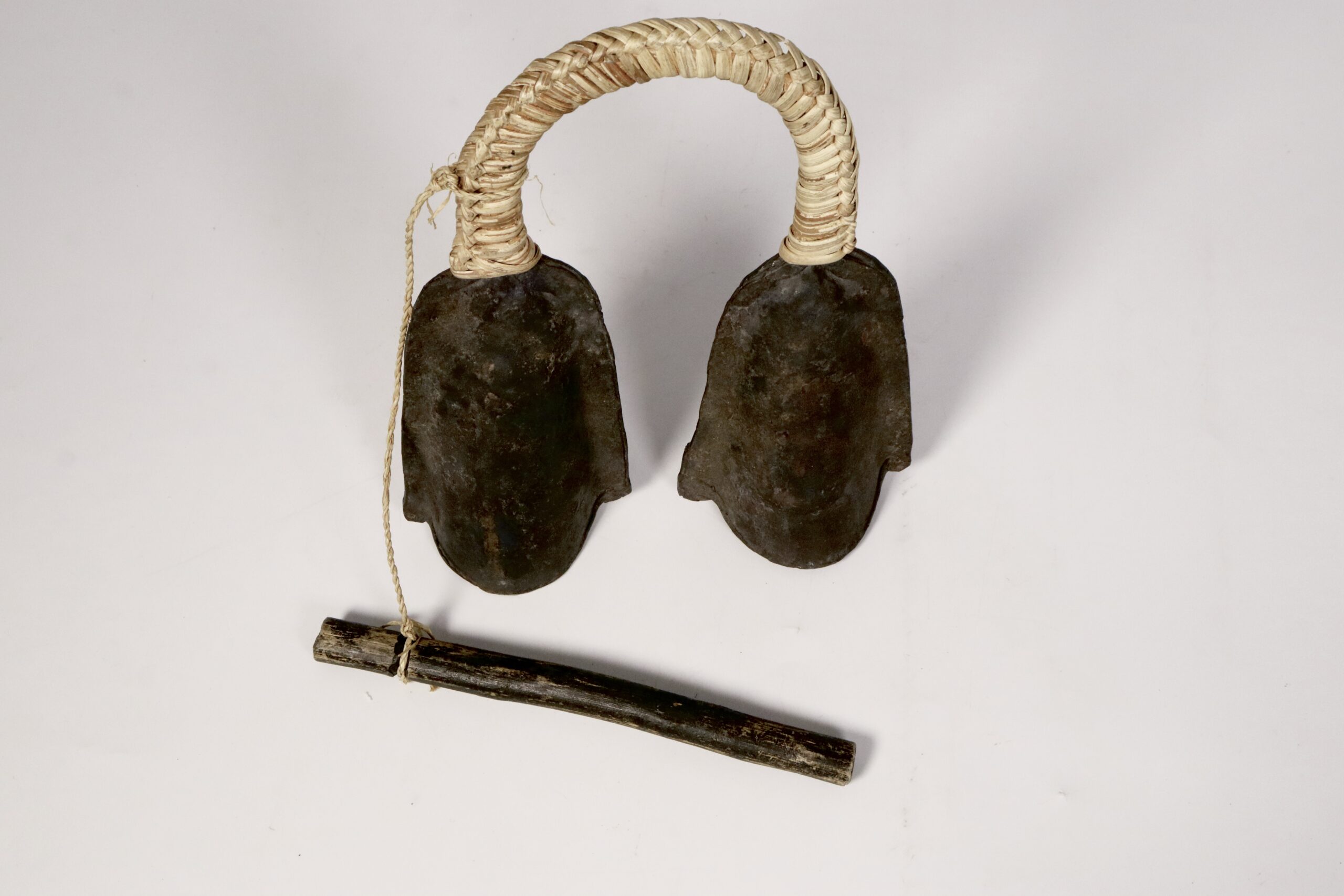
  • Kwi’fo

    Kwi’fo

    Title:  Kwi’fo  

    Item Type: double bell  

    Key Words:  

    Kwi’fo, Kwi’fou, Nzeme Mmo, Bamileke, Cameroon, double bell, musical instrument  

    Dimensions: Each bell is 8cm x 20cm (including the handle) 

    Materials: Metal (most likely iron), raffia, twine 

    Production methods and techniques:

    Unknown, but likely iron smelting and forging techniques were used.  

    Condition: Good. 


    Description

    A pair of double bells with a raffia wrapped handle. It is accompanied by a separate metal gong, attached to the bell’s handle with twine.  

    Function:

    This double bell is common to Northwestern Cameroon and is likely to be associated with the Bamileke people of the Cameroon grasslands. The kwi’fo is a symbol of the Kwifoyn, one of the all-male societies of the Bamileke people, who worked in close proximity with the king to govern. The bell holds sacred value and represents the power and prestige of this organisation. It is ceremonial and is used in royal dance ensembles, for example to announce the arrival of the king during a ceremony. It can also be used to communicate with ancestors and the supernatural. The pitches of the two bells are typically an interval close to a major second apart.  


    Provenance

    Name of creator: Unknown, but likely by the Bamileke people.  

    Where the item was created/made:

    Unknown, but likely in the Cameroon grasslands region.  

    Date Made: Unknown 

    Acquisition:

    Unknown, but it was likely obtained by a PhD student of a member of staff at the University of Edinburgh during fieldwork and was then donated to the University of Edinburgh’s Social Anthropology Teaching Collection, where the Social Anthropology Department now has ownership. The nature of the acquisition is unknown.   

    Acquisition date: Unknown, but likely pre-1980s.   

    Current Location: 5th floor of Chrystal MacMillan Building on display. 


    General Notes

    The name kwi’fo refers to the group of counsellors and delegates of the king, symbolised by the double bell. Whilst the kwi’fo refers to its sacred use, the name nzeme mmo is used to refer to the double bell as a singular object.    

    Sources:  

    Schrag, B.E. (2005) How Bamiléké music-makers create culture in Cameroon. PhD thesis. University of California.   

    Majolie Carine, D.T., Guia, E & Mbessa, M. (2024) The Concept of Aspectism in the Traditional Arts of the Bamileke People of Western Cameroon: Myth or Reality?. Available at SSRN: doi: 10.2139/ssrn.4844818.  

    Other Associations:

    There is a potential link to objects SA041, SA014, SA044 and SA045 in the collection, as they could be from the same region and used in similar dances and performances, but this needs further researching.  

    Name of cataloguer: Astrid Everall  

    Date: 07/03/2025  

    Accession Number: SA 040

  • Naive Wonder and Shared Humanity 

    Naive Wonder and Shared Humanity 

    by Aisling Kelly


     Hidden in the back of the Oxford Natural History Museum, the Pitt Rivers museum is an expansive ship-like room. With its dark walls, four balcony terraces, and cases wedged between cases like sardines, it feels like a real life ‘Eye Spy’ –  as if the whole world is condensed into this one room. Visiting frequently as a child, I spent hours wandering the balconies, imagining the stories behind each object, thinking of some little girl in India, hundreds of years ago, also playing house with her dolls.

    Questioning what unites the human experience left a deep seed of curiosity within me, ultimately inspiring me to pursue my undergraduate degree in Anthropology and (upon further reflection) this course itself. Yet, this course has pushed me to deeply reflect on this wonder and admiration – now looking back on these memories, I realise my profound naivety. 

    While museums can be places of wonder and discovery, I now understand the deeply violent history ethnographic museums hold. Historically, the accumulation of objects was justified on the basis that ‘primitive’ people needed help from ‘civilised societies’ to properly conserve them. Aside from blatant stealing and cultural erasure, objects were also often displayed as ‘exotic’ spectacles. Through these displays, public institutions like museums have been complicit in upholding wider societal power structures through the voices they choose to uphold and silence. Speaking about these objects from a Eurocentric perspective, ethnographic objects remained deeply entangled with colonial power relation, remaining explicit in the maintenance of these dynamics in a post-colonial era.

    Understanding this baggage and background was also embedded in our collection of anthropological ‘artifacts’ that has ushered in challenging conversations on how to best approach them – how can we ensure that these objects not only obtain the correct care they deserve, but how can we ensure these objects become sites of agency, learning, and conversation, rather than reproducing colonial hierarchies?

    Much of our work so far on this project has therefore centered around the concept of creating ‘contact zones’ in ethnographic museum collections. The concept reimagines the museum as a centre point for gathering and dialogue, rather than a top-down, omnipresent voice of knowledge. This approach compels both curators and visitors to critically reflect on their relations to the objects, recognising the complex social and power dynamics ingrained within them. The hope here is that museums can transition from hierarchical and static institutions to dynamic spaces. 

    Our blog posts, like this one, hope to be a direct practice of contact zones. Not only are they an opportunity for us to critically reflect on our relation to the objects and the host of histories and baggage that they (and the entire discipline of anthropology) bring with them, but we hope the comments section at the bottom can serve as an opportunity to create active and dynamic conversations with anyone who comes across our pieces. At the moment, our limited scope of time and outreach means we haven’t been able to get in touch with origin communities of these objects. However, our hope is that such an online platform will help to increase this global connectivity and pave the way for future collaboration and conversation. 

    While I applaud our efforts, I don’t believe that our collection has now achieved ‘decolonisation’ and deeply question if we ever officially reach this enlightened state. Without direct contact and conversation with origin communities, we are still a western institution speaking on behalf, and handling, these objects. Yet, I still strongly believe this doesn’t mean we shrug our hands and walk away.

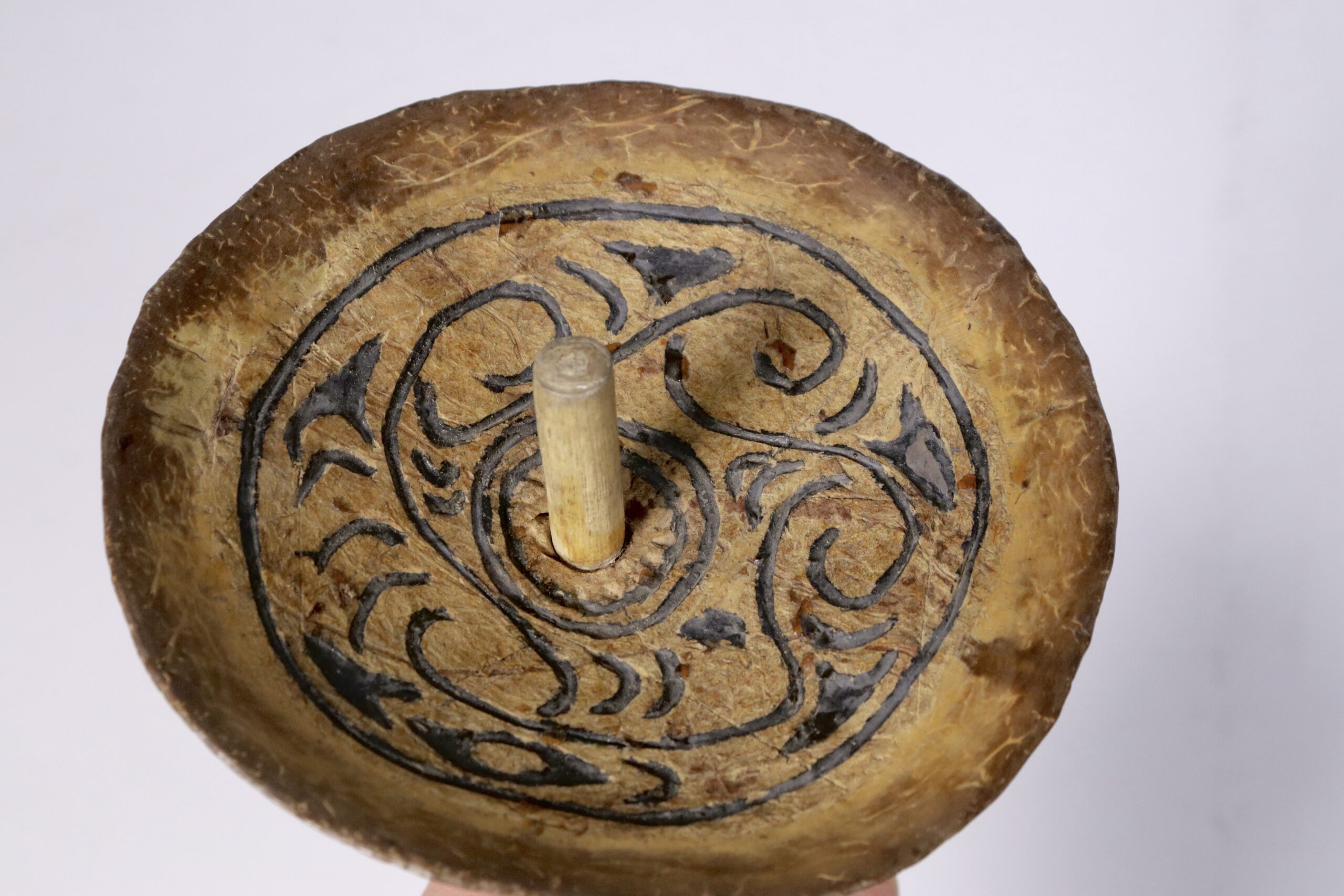
    Doing province research on the Spinning Top Coconut Toy reminded me of what originally drew me to both Anthropology and museums. Growing up visiting the Pitt Rivers, the toy section was always by far my favourite. Staring at these objects, I felt a deep shared connection – a moment of realization that despite the vastness of the world, our shared humanity unites us all. We all have an innate desire to play and connect with others, to gather over a meal, to dress up and dance.

    Particularly amidst the political and global chaos that has ensued throughout the timeline of this project, this realisation has equally affirmed my belief that we need anthropological collections now more than ever. Even despite their futility and shortcomings, these objects remind us of what unites us all. Now the challenge remains, to create these spaces as places of shared connection and conversation, rather than rebuilding colonial barriers which seek to oppress and divide. 

  • Sowei Mask (2)

    Sowei Mask (2)

    Title: Sowei mask

    Item type: helmet mask   

    Key Words: Sowei, Bondu, Bundu, Mende, Sande, Sierra Leone, Kenneth Little, mask

    Description:  

    A wooden helmet mask. It possesses neck rings, a detailed coiffure, downcast eyes and a composed facial that are typical of the sowei mask. This particular example has a particularly long neck, with ten neck rings. The eyelids are considerably larger than the nose, pursed lips, and ears.  

    Function:   

    Sowei masks are attributed to the Sande (also known as Bundu or Bondo), an all-female secret society in Sierra Leone, Liberia, Guinea and the Ivory Coast. The mask is worn during the end of girls’ initiation ceremonies when a ritual dance is performed by the society leader – the ndole jowei (dancing sowei). Usually worn with a raffia costume, the identity of the wearer is entirely concealed. It is believed that the sowei mask represents ideals of feminine beauty, with the full forehead representing wisdom and intellect, and the ringed neck embodying physical beauty and fertility in Mende society. This mask is likely a Mende sowei mask from Sierra Leone.   

    Dimensions:   

    Materials:  Wood 

    Production Methods and Techniques:

    Sowei masks are carved by men from a single piece of wood in Mende society but are only worn by women. They are dyed with vegetable dye for a darker tint on the mask.  

    Condition:


    Provenance

    Name of creator: Unknown   

    Where the item was created/made: Sierra Leone  

    Date Made:  

    Unknown, but it is likely to have been made during or prior to the 1940s, when Kenneth Little performed his ethnographic fieldwork in Sierra Leone.   

    Acquisition:

    We believe that the object was acquired by Professor Kenneth Little during his fieldwork in Sierra Leone. The object was brought to the University of Edinburgh and was donated to the Social Anthropology Teaching Collection. The nature of this acquisition is unknown.  

    Acquisition date:  

    It was likely acquired in the 1940s during Kenneth Little’s fieldwork in Sierra Leone. It was likely donated to the Social Anthropology Teaching Collection after Kenneth Little joined the University of Edinburgh in 1950.    

    Current Location:

    5th floor of Chrystal MacMillan Building on display.   


    General Notes

    Sowei masks are given a name in Mende society, but we do not know the name of this specific mask.       

    Sources:

    Little, K. L. (1949). ‘The Role of the Secret Society in Cultural Specialization.’ American Anthropologist, 51, no. 2: 199–212.  

    Otto, Kristin. (2020) ‘Creating the Sowei: Repairing and Interpreting Sowei Masks in Global Assemblages.’ Order No. 28027290, Indiana University.   

    Phillips, R. B. (1979) ‘The Sande Society Masks of the Mende of Sierra Leone.’ PhD diss., School of Oriental and African Studies, University of London.   

    Recommended site for further research:

    Sierra Leone Heritage  

    Name of Cataloguer: Zahra Abdalla   

    Accession Number: SA031

This website uses Google Analytics to gather usage statistics. Please accept or reject.

Cookie preferences