Title: Thammattama Bera
Item Type: Bongo drums
Key Words: Thammattama, bongo drum, drum, Sinhalese, Sri Lanka, musical instrument, Anthony Good
Materials: Wood (possibly from Kohomba, Ehela and Jak trees), animal skin/fibres, cotton
Dimensions: 40cm x 20cm
Description:
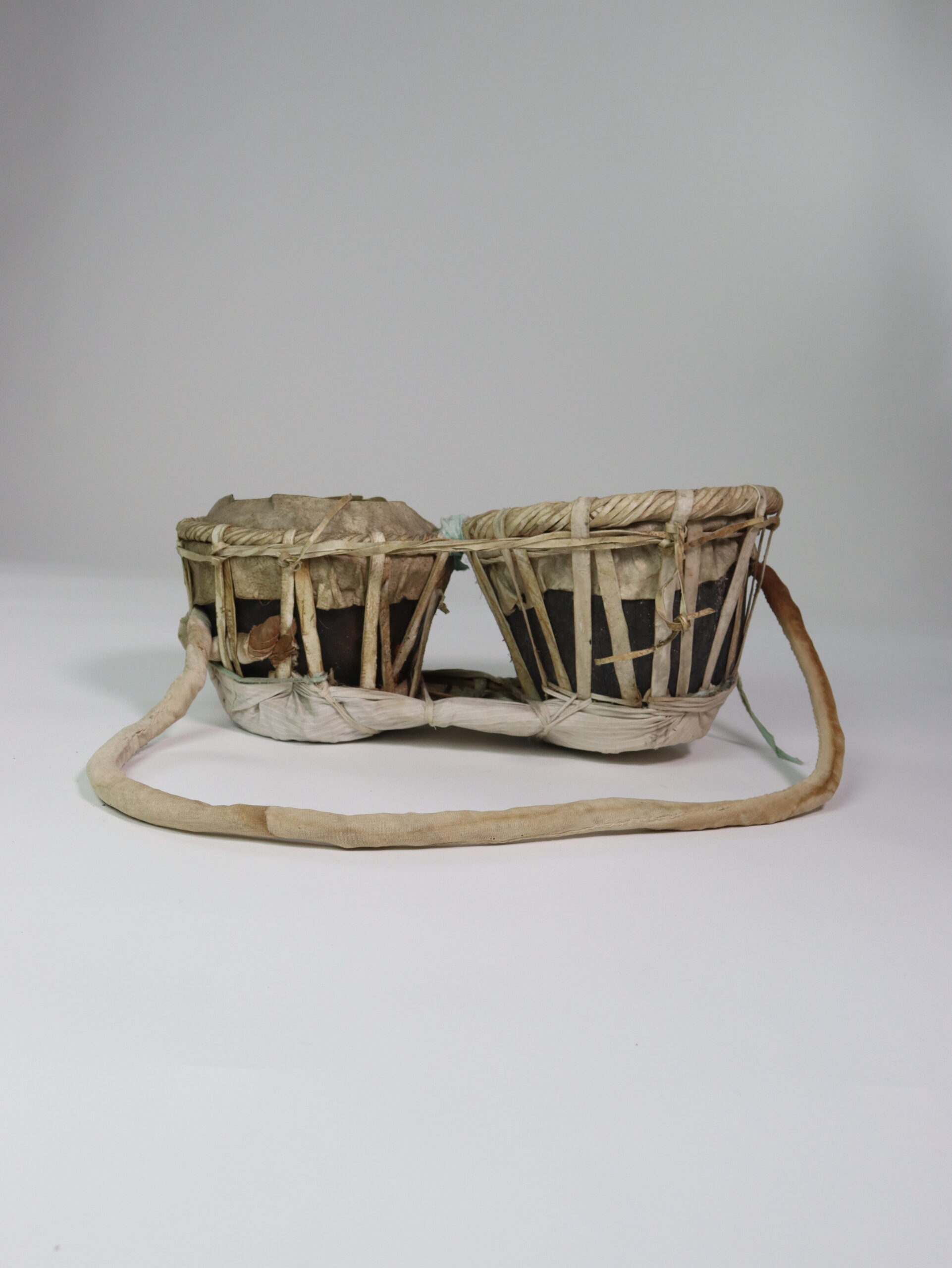
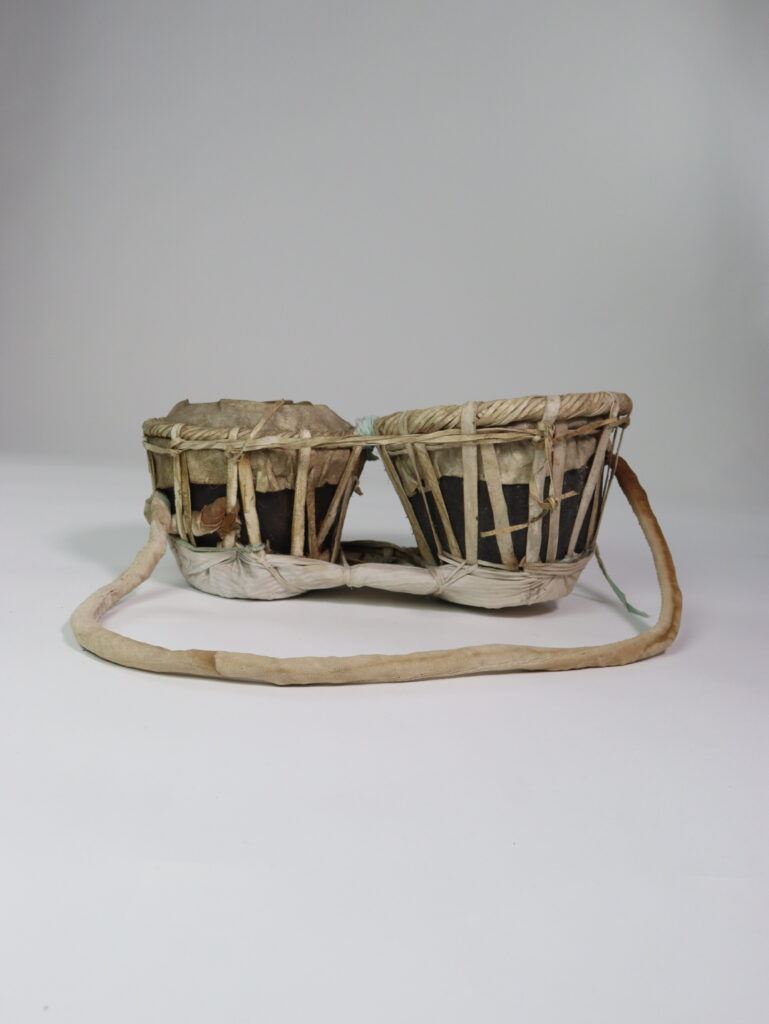
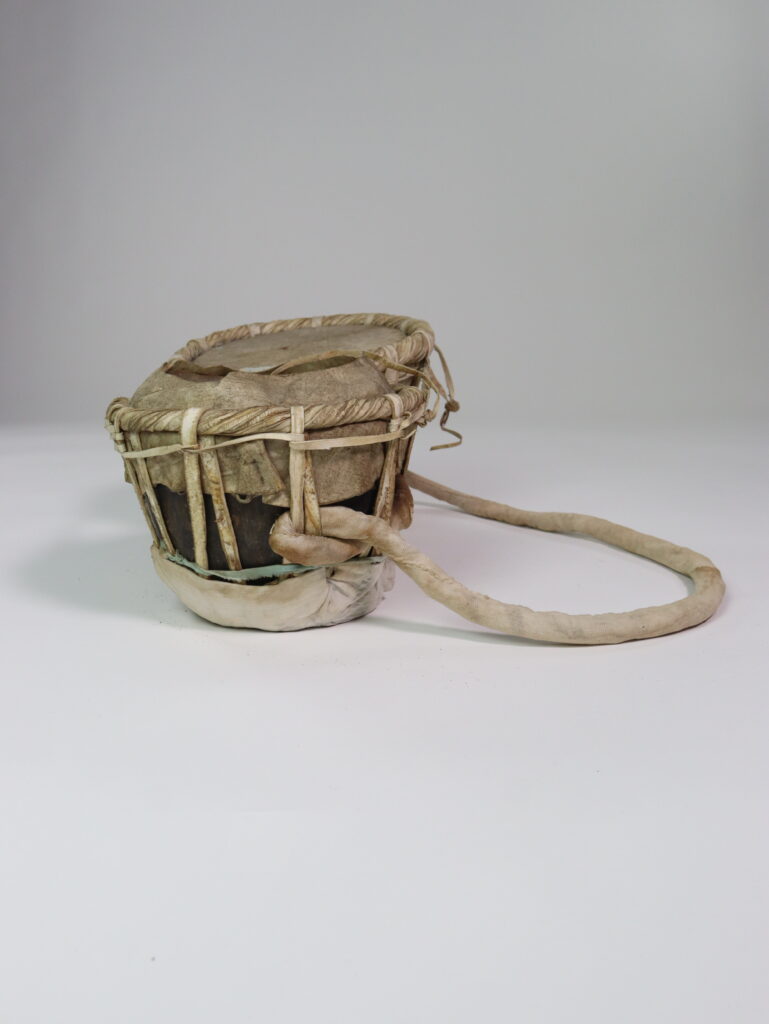
Bongo drums with a neck strap. The two wooden bowls of the drum are connected by strips of skin and two wooden rods on the sides. The membranes are held by a band of twisted fibres that encase the edge of the drums and are connected to a second fibre on the underside of the drum with ten vertical strips of skin. A thick fibre band (urapota) wrapped in cotton fabric is tied to the skin strips on both outer sides, forming the drum strap.
Function:
The Thammattama Bera consists of two parts, with high sounds produced by the right drum and low sounds produced by the left drum. It is played with two sticks with circular ends rather than with hands. Thammattama is generally not played with equal pressure. There are special rhythms played on this drum used in Buddhist processions, to invite people into the temple, invite Buddhist priests for Pirith ceremonies or for alms giving. In Buddhist processions, the players move in fixed steps to the constantly repeated basic beat of their drums, which is beaten with the left hand, while the right hand adds complicated rhythmic variations. Occasionally, the players use their forearms and elbows as an artistic element in addition to the sticks. In conjunction with the Dawula, the Thammattama fills out the rhythmic cycle set by the cylinder drum.
The Thammattama holds significance in Sinhalese society, where, during the times of the Sinhalese kingdoms, Bera were used to announce official decrees and the army marched into battle with war drums (Rana Bera).
Production Methods and Techniques:
It is usual to have a ceremony to begin the production of the Thammatta Bera. However, due to increased commercialisation in regions where these drums are made, it is possible that these ceremonies are ignored.
Condition:
Fair. There are signs of wear to the bounded fibres and cotton. The two circular bound sticks that are used to play the Bera are missing from the one in our collection.
Provenance
Name of creator: Unknown
Where the item was created/made: Unknown, but likely Sri Lanka
Date Made: Unknown
Acquisition Date: Unknown, but likely pre-1980s.
Current Location: 5th floor of Chrystal MacMillan Building on display.
Acquisition:
This object was possibly acquired by Professor Emeritus Anthony Good during his ethnographic fieldwork in Sri Lanka and then donated to the University of Edinburgh’s Anthropology Teaching Collection by him, where the Social Anthropology Department now has ownership. The nature of this acquisition is unknown.
Name of Cataloguer: Ariela Silber
Date: 05/03/2025
Assession Number: SA035