Title: Yayrapen
Item Type: Arrows
Key Words: Yayrapen, Puang, Papua New Guinea, arrows, wood, Hooshang Philsooph, weaponry
Dimensions: 97cm x 0.75cm
Materials: Wood (likely betel nut), feathers (either lory, cockatoo or parrot), breadfruit tree saps, bamboo ashes, paint (made from Hapin)
Production Methods and Techniques: Unknown, but likely carving and cord plaiting processes were used.
Condition: Good
Description
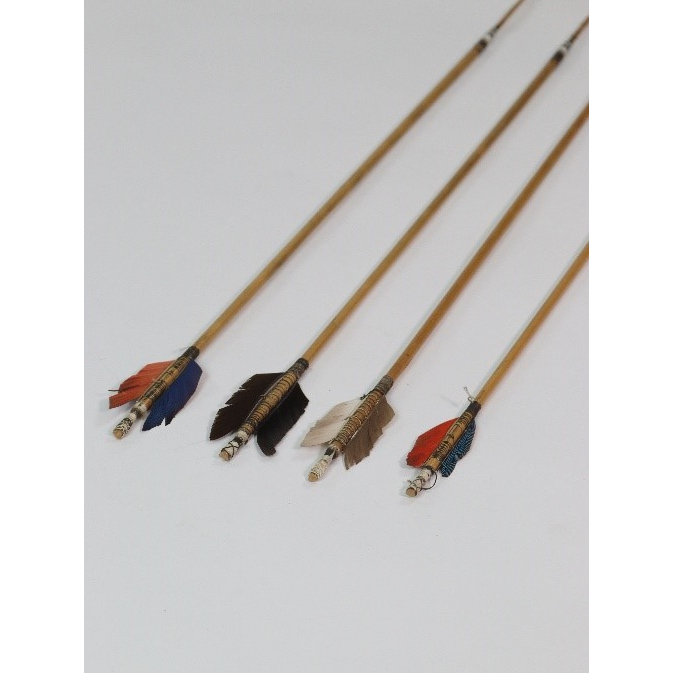
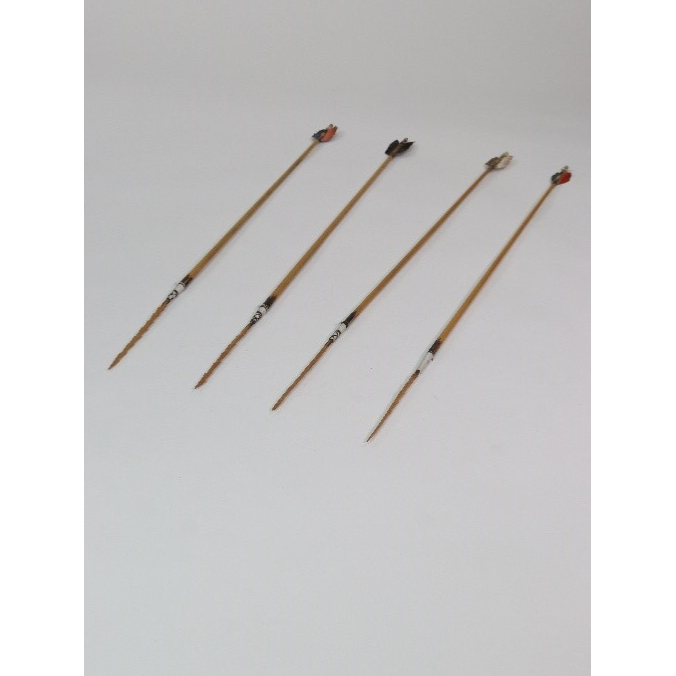
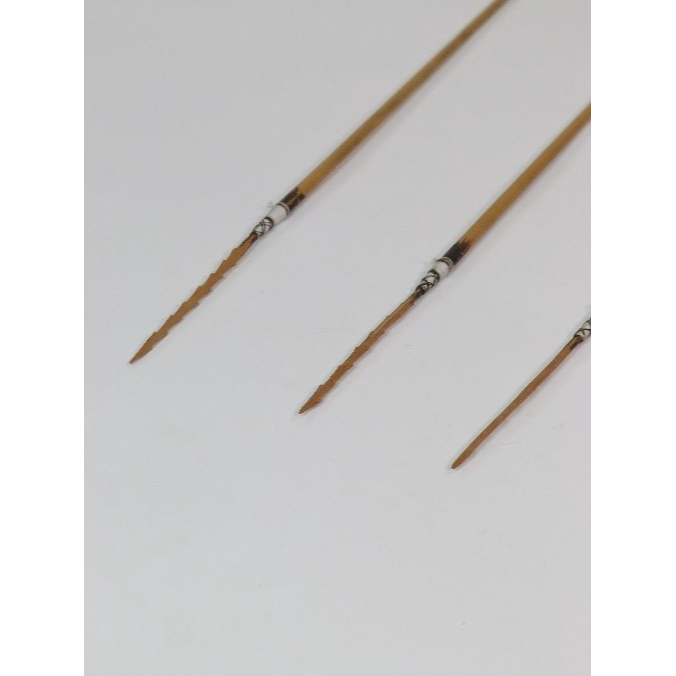
Four barbed betel nut wood-made arrows with multi-coloured feathers (these objects were previously categorised as spears but after research was undertaken, we have since distinguished them as arrows). These Yayrapen have barbed arrowheads with sharpened tips. Black and white threads and black paint decorate and secure the arrow hafting. The arrow shafts are a light brown wood, straight and smooth to touch. The fletchling are made with multi-coloured feathers fastened by black and white twine threads (two are red and blue, one is dark brown and one is beige and light brown). Black and white threats plait around the nock of the arrow, displaying visible arrow dents.
Function:
Yayrapen is a type of arrow mainly used by the Puang people from Papua New Guinea. They are used to injure or possibly kill men, and to hunt pigs and cassowaries. The shapes and uses of these arrows are related to Puang people’s ‘destructive magic’: to diminish or hurt enemies’ souls, indigenous magicians will make different ‘magical bundles’ that resemble these arrows to curse their counterparts. This relates to a basic perspective in Puang warfare that drawing enemies’ blood can sometimes be more important that killing the enemy, as personal belongings (or blood) can be used in ‘destructive magic’ to harm their souls. It is notable that the term Yayrapen is not the overall name for all Puang magical arrows, but only refers to one kind of arrow, amidst other Puang weaponry used for purposes of ‘destructive magic’.
Provenance
Name of creator: Unknown
Where was the Item created/made: Unknown, but likely Papua New Guinea.
Date Made: Unknown
Acquisition:
Unknown, but these objects were potentially acquired by Professor Hooshang Philsooph during his ethnographic research in Puang, West Sepik, Papua New Guinea and donated to the University of Edinburgh’s Social Anthropology Teaching Collection by him, where the Social Anthropology Department now has ownership.
Acquisition Date:
Unknown, but potentially acquired between 1971-1973 during Professor Hooshang Philsooph’s fieldwork.
Current Location: 5th floor of Chrystal MacMillan Building on display.
General Notes
Sources:
Philosooph, H. (1980) A Study of a West Sepik People, New Guinea, with special reference to their system of beliefs, kinship and marriage, and principles of thought. PhD thesis. University of Edinburgh.
Name of Cataloguer: Yiyang Wen
DATE: 07/03/2025
Assession Number: SA052.1-52.4