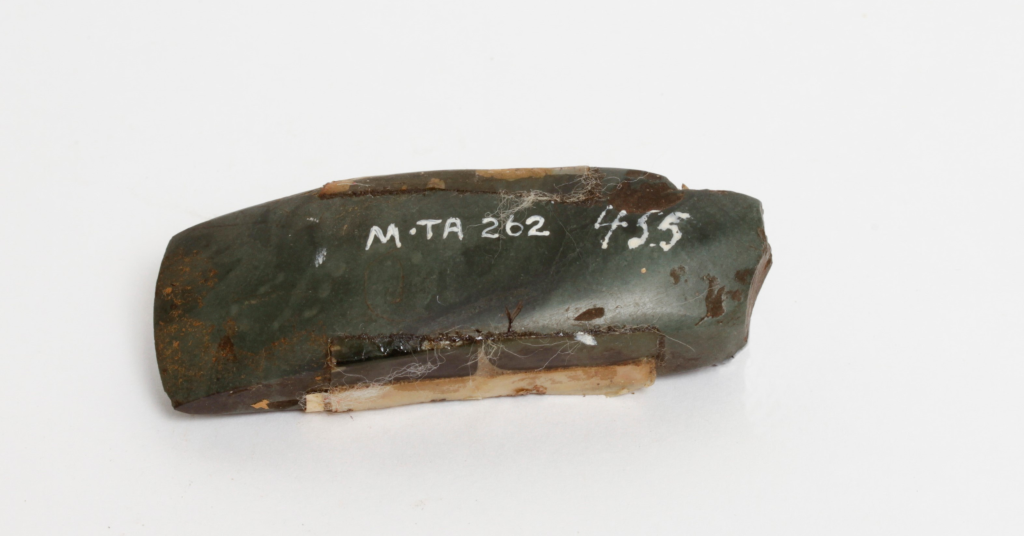
Title: Adze blade
Item Type: Ceremonial axe
Key Words: Adze, greenstone, blade, Massim, Papua New Guinea, weaponry
Dimensions: 9cm x 18cm
Materials: Chloromelanite stone
Condition: Fair. The blade has several scratches and dents around its rim.
Description:
A carved green stone. This stone is likely to be the blade of a ceremonial axe, an adze blade, from the Massim regions of Papua New Guinea. The axe blade is inserted into a wooden handle that is shaped like a slightly tilted 7 and fastened into the handle by wrapped fibres that hold the blade in place.
Function:
As a prestige item, adze blades were carried or worn in the belt for adornment on special occasions such as sing-sing and moka exchanges. Due to the risk of breaking the thin blade, they were only used for cutting off fingers as a sign of grief and sometimes in close combat. They were also used as money to buy other commodities, such as salt, body oil, shells and brides. The axes were used ceremonially as ‘strength-giving ornaments’ in the ceremonial dances during the Konggol. The wooden handles that hold the stone are only temporary supports for the blade, carved especially to carry and display the stone during exchange ceremonies. Once it has been inserted in the haft, the stone blade is marked for presentation and exchanged, after which the handle is often discarded until the next exchange cycle demands that a new one be carved.
Indigenous Massim people would use stone axes and tools until colonists from Australia introduced steel tool in the mid-20th century, however, it is suggested that the polished axe stones maintained their value as ceremonial valuables that were traded between communities. The axes that are created today are identical to those made in the past, except that most of the stone used now is softer and more fragile as it is easier and quicker to work with.
Production Methods and Techniques:
It is suggested that these stones were quarried from a cave in the volcanic regions of the Massim Islands in Papua New Guinea. Cracks are produced in the solid rock, partly by hammering it with wooden billets and partly by alternately heating it with fire and pouring cold water on it. Next, wedges were forced into the cracks and blocks broken free. Archaeological evidence points to a long-extinct greenstone tool industry centered around the quarry of the Suloga hills in Muyuw (Woodlark Island).
Provenance
Name of Creator: Unknown
Where the Item was created/made:
Likely the Southern Isles of Papua New Guinea
Date Made: Unknown
Acquisition:
Unknown, but it was likely obtained by a PhD student of a member of staff at the University of Edinburgh during fieldwork and was then donated to the University of Edinburgh’s Social Anthropology Teaching Collection, where the Social Anthropology Department now has ownership. The nature of the acquisition is unknown.
Acquisition Date: Unknown
Current Location: 5th floor of Chrystal MacMillan Building on display.
General Notes
Name of Cataloguer: Annabel Macdonald
Date: 05/03/2025
Assession Number: SA049