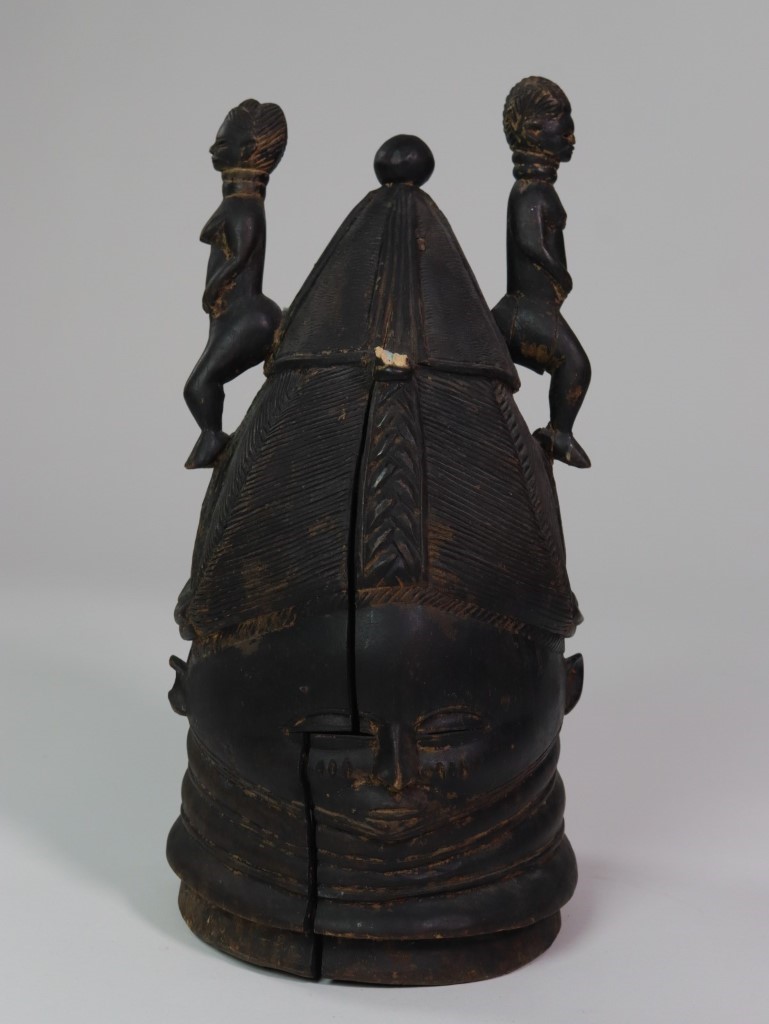
This beautifully crafted wooden mask originates from West Africa and is adorned with intricate carvings and symbolic patterns. Tribal masks like this one are often used in ceremonial dances and rituals, representing deities, spirits, or ancestors. The detailed artistry reflects the cultural heritage and traditions of the region.
Significance: Masks like this play a key role in storytelling, spirituality, and identity, offering insight into the values and beliefs of the communities that create and use them.

Title: Sowei mask
Item Type: helmet mask
Key Words: Sowei, Bondu, Bundu, Mende, Sande, Sierra Leone, Kenneth Little, mask
Dimensions: 45cm x 23cm
Materials: Wood and likely vegetable dye
Description:
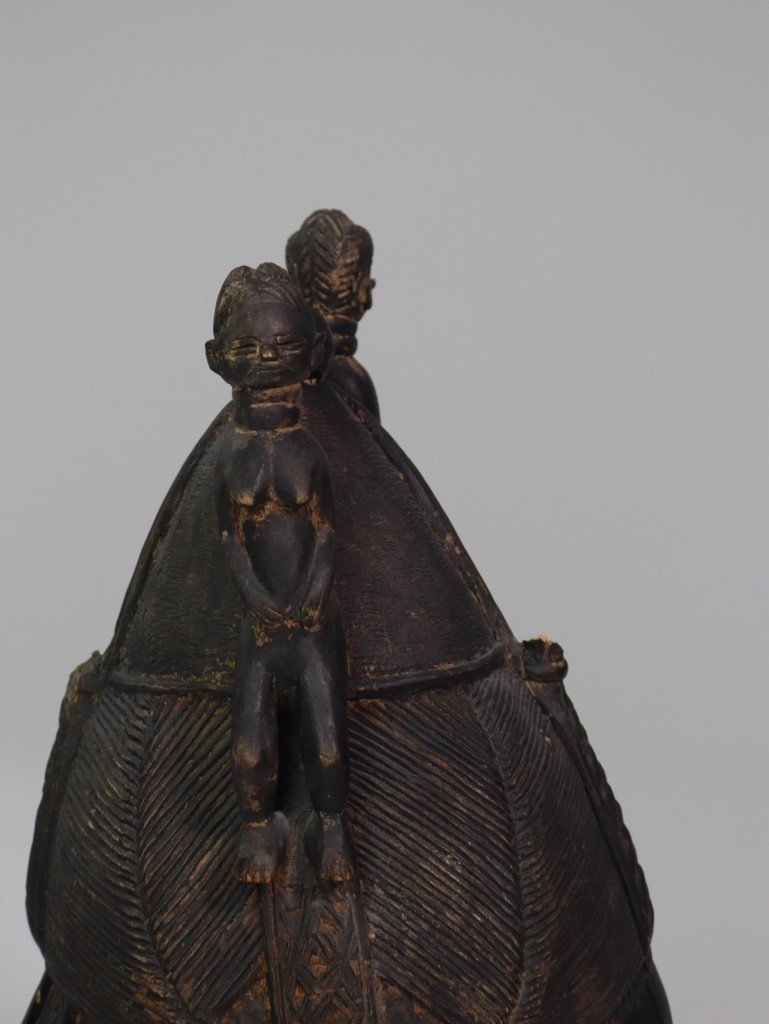
A wooden helmet mask that is dyed black. It possesses neck rings, a detailed coiffure, downcast eyes and a composed facial expression that are typical of the sowei mask. This particular example has two female figures on either side of the head. The eyes have been made into slits and there are three scarification marks on each cheek. The hairstyle is engraved with zig-zag lines and two plaits at the front and back of the head. The hair meets as a ball on the top of the head. On the back of the head, there are nine flap-like forms, each engraved with varying patterns, that mark the base of the hairline.
Function:
Sowei masks are attributed to the Sande (also known as Bundu or Bondo), an all-female secret society in Sierra Leone, Liberia, Guinea and the Ivory Coast. The mask is worn during the end of girls’ initiation ceremonies when a ritual dance is performed by the society leader – the ndole jowei (dancing sowei). Usually worn with a raffia costume, the identity of the wearer is entirely concealed. It is believed that the sowei mask represents ideals of feminine beauty, with the full forehead representing wisdom and intellect, and the ringed neck embodying physical beauty in Mende society. This mask is likely a Mende sowei mask from Sierra Leone.
Production Methods and Techniques:
Sowei masks are carved from a single piece of wood and hollowed out so it can fit over the wearer’s head. They are dyed with vegetable dye for a darker tint on the mask. Though sowei masks are exclusively worn by women in Mende society, they are carved by men. The carving of a sowei is considered a challenge in Mende society, due to the variance in carving and the special status attributed to the sowei masks. Each carver tends to have their own personal style, where they have the opportunity to demonstrate their artistic skill.
Condition:
Poor/damaged. There is extensive chipping and damage to the surface, although the black colour has been retained. Some pieces have broken off and been lost, including the leg of one of the female figures, part of the left ear and an attachment at the back. The piece broken off at the front of the mask has been retained as SA029.2. There is a vertical crack running across the face and through the left eye.
Provenance
Name of creator: Unknown
Where the item was created/made:Sierra Leone.
Date made:
Unknown, but it is likely to have been made during or prior to the 1940s, when Kenneth Little performed his ethnographic fieldwork in Sierra Leone.
Acquisition:
It was likely acquired in the 1940s during Kenneth Little’s fieldwork in Sierra Leone. It was likely donated to the Social Anthropology Teaching Collection after Kenneth Little joined the University of Edinburgh in 1950.
Current Location: 5th floor of Chrystal MacMillan Building on display.
General Notes
Sowei masks are given a name in Mende society, but we do not know the name of this specific mask.
Sources:
Little, K. L. (1949). ‘The Role of the Secret Society in Cultural Specialization.’ American Anthropologist, 51, no. 2: 199–212.
Otto, Kristin. (2020) ‘Creating the Sowei: Repairing and Interpreting Sowei Masks in Global Assemblages.’ Order No. 28027290, Indiana University.
Phillips, R. B. (1979) ‘The Sande Society Masks of the Mende of Sierra Leone.’ PhD diss., School of Oriental and African Studies, University of London.
Reinhardt, L. (1975) ‘Mende carvers’. PhD thesis, Southern Illinois University.
Recommended Sites for Further Research: Sierra Leone Heritage
Name of Cataloguer: Astrid Everall
Date: 06/03/2025
Acquisition Number: SA029