Author: cass

  • Astrid’s Reflection

    As a child growing up in London, I had the privilege of visiting the various museums and collections available to the public, with the British Museum offering a popular option for a school trip. My experience of wandering through exhibitions and displays is something that sparked my interest in anthropology and material culture, however, now as an anthropology student, I am well aware of these institutions’ colonial legacy and their role in past and ongoing violence. I have also been taught to consider my positionality, meaning it has become critical for me to reflect on my perspective as a museum spectator, encouraging me to ask: what is my role in reimagining museums and collections?  

    When I was thinking about this question, I remembered two exhibitions: Fred Wilson’s Mining the Museum (1992-1993) in The Maryland Historical Society and the recent intervention in the British Museum, what have we here? (2024-2025) by Hew Locke. The starkness, irony and sheer horror of Wilson’s exposé, including a baby carriage containing a Ku Klux Klan hood and slave shackles positioned alongside silverware, made it a revolutionary exhibition within both the art world and museum culture. Now thirty-two years later, Hew Locke’s excavation of one of the most infamous museums in the world implicitly invites us to demand what, exactly, has changed since Mining the Museum opened in 1992?  

    As Locke deliberately uses the words loot and looting to uncover the journeys of various objects that have been erased by the institution, we can see there is a long way to go before museums fully address their active participation in imperialism and their continued reproduction of colonial violence. What struck me the most were the colourful figures of The Watchers that become part of the museum, hovering in corners and lurking behind curtains. As they point and silently observe, The Watchers call on the museum visitors to address their internalized complicity as they walk through the exhibition. Under their judging eye, the spectators become an exhibit, their unconscious bias and cognitive dissonance making them a part of the structure of the museum and its ongoing brutality.  

    By making his visitors culpable, Locke illuminates the complicity of the museum spectator. The tendency for museum visitors to don a gaze that is unquestioning, exclusionary, essentializing and comfortable, demonstrates our need for introspection when we walk through these exhibitions. While conversations about decolonising museums are often centred around curatorial and institutional change, this shows that only by approaching our personal discomfort can the museum and the spectator work together to cast off the language of empire we have received via museums.  

    Despite the need to question both ourselves and our institutions, Locke’s aim is not for the exhibition to be a ‘miserable show’. When Locke displays objects that have been scorched and damaged as they were looted, he doesn’t shy away from exposing their “messy” and violent histories. Yet, though his exhibition is designed to shock, he also intends to create a space for long overdue dialogue. It is through eliciting uncomfortable conversations and unsettling our preconceptions that I believe museums and collections can retain their value. By reimagining them as sites for learning about our colonial past and thinking about how we are implicated in this history, there could be a way to still incite that curiosity about different cultures and peoples that I had as a child. After all, the success that Mining the Muesum had in communicating the violence of empire, and the entrenched nature of slavery and racism to the public, is testament to the impact that collections and museums can have, when they are re-conceived to unsettle the status quo and oppressive structures of power.  
  • Beyond Visuality and into an ESP framework  

    Beyond Visuality and into an ESP framework  

    by Ariela Silber  

    Christina Hodge’s interdisciplinary ‘Experiential Observation + Synesthetic Analysis + Polysemous Interpretation’ (ESP) framework integrates visual analysis and multisensory observation with anthropological insights. It seeks to enhance understanding of material culture while promoting decolonization in anthropological practices through distortion and reflection of the western gaze. This contends with material culture study and moves beyond museum objects, as props exhibited to illustrate stories written by placards but instead produces a framework that allows a cultural competency, reflexivity, grounded within cultural relativism. In placing art under the focus of anthropology, a disruption of the “curational gaze” (Hodge 2018: 143) is established, where human subjectivity and meaning is emphasised in comparison to judgement based on an objects’ formal qualities which risk self-referential connoisseurship that detaches objects from their cultural and political contexts. Hodge’s ESP framework carefully acknowledges and mitigates the pervasiveness of the distanced gaze and ocularcentrism by incorporating multisensory experiential analysis at the forefront.  

    The project work we undertook with the Social Anthropology Teaching Collection is enmeshed with the colonial domination that Anthropologists in our institution propagated. When first establishing provenance work, research and creative outputs, a necessity to be in proximity with the objects was forefront. Our aim of emulating and adapting Hodge’s framework guided our ways of knowing beyond the visuality, with the co-presences of ourselves and our objects reaching all senses. Our thoughts, ideas and designs seen in our website, zine and catalogue are encouraged to challenge and destabilise the established inequalities which brought these objects into our custodianship, aiming for personal and institutional reflexivity, grounded within relativism. We usher active engagement from readers, academics and publics about our curatorial choices but go in knowingly that our position is representing an institution which remains embedded in facilitating its colonial pasts and presents. 

    Ariela Silber  

    References:  

    Hodge, C. J. (2018). Decolonizing Collections‐Based Learning: Experiential Observation as an Interdisciplinary Framework for Object Study. Museum Anthropology, 41(2), 142–158 

  • Suwau Headdress/headband DUPLICATE

    Suwau Headdress/headband DUPLICATE

    Title: Suwau  

    Item Type: Headdress/headband  

    Key Words:  Puang, Papua New Guinea, shells, Hooshang Philsooph 

    Dimensions:   45cm x 6cm  

    Materials:   

    Shell rings (takei), embroidery string (pirik), fibrous sheet (potentially made of barkcloth or coconut palm tissue) and rattan cords  

    Production Methods and Techniques: Unknown, but likely embroidery techniques.   

    Condition:  Good.  


    Description:  

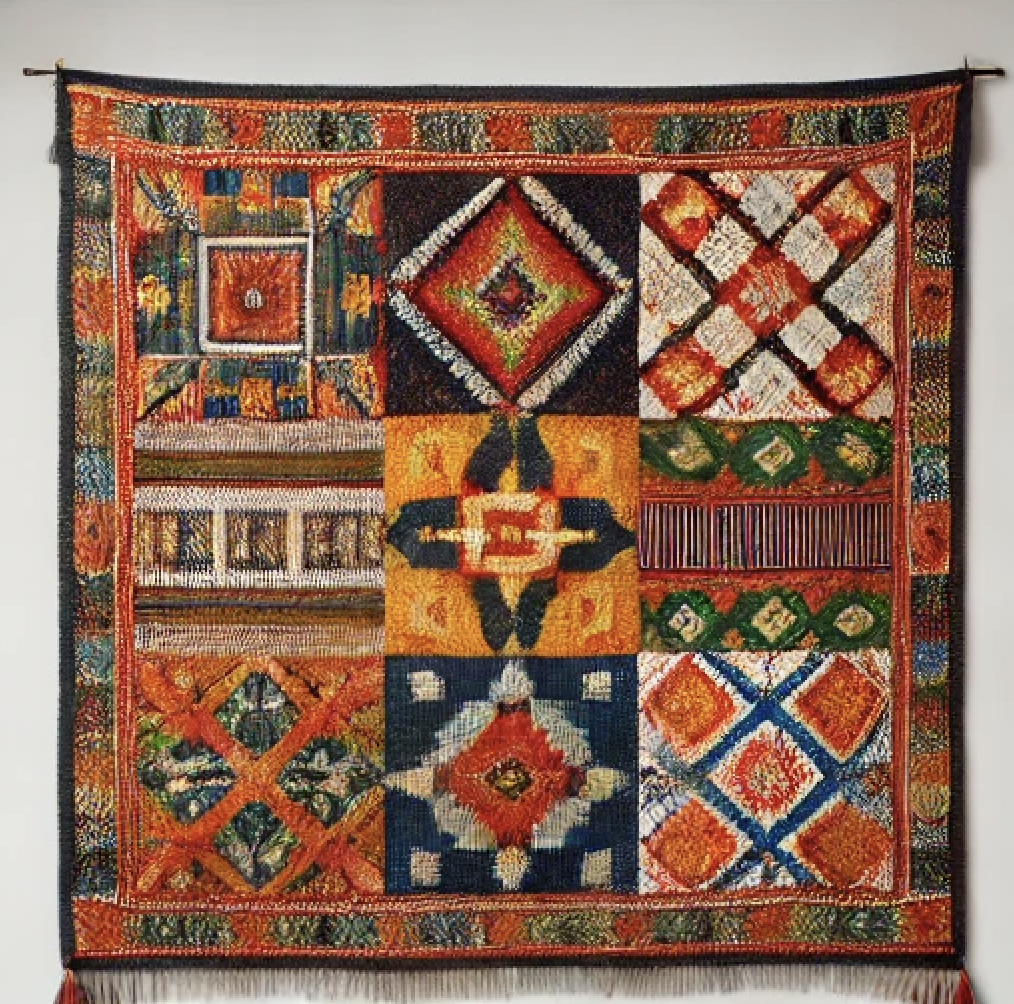
    Headdress made from fibrous sheet that is embroidered with shell rings, with circular patterns in the centre and tapered ends. A cord is attached to either side of the sheet, which presumably is used to tie to head. This item was previously catalogued as a belt but we believe it is more likely to be a headdress.  

    This vibrant ceremonial textile, woven with intricate embroidery, comes from Southeast Asia. The fabric is decorated with bright colors, geometric patterns, and symbolic motifs, often representing spiritual or social themes.

    Significance:

    Ceremonial textiles serve both functional and symbolic purposes, used in celebrations, rituals, and as markers of social status or cultural identity.

    Function: 

    In Puang communities, suwau is part of the bride-wealth and used in land buying or exchanged in peace-making rituals, post warfare.  


    Provenance   

    Name of Creator:   Unknown  

    Where the item was created/made: Likely Papua New Guinea.  

    Date Made:  Unknown  

    Acquisition:  

    Unknown, but these objects were potentially acquired by Professor Hooshang Philsooph during his ethnographic research in Puang, West Sepik, Papua New Guinea and donated to the University of Edinburgh’s Social Anthropology Teaching Collection by him, where the Social Anthropology Department now has ownership. 

    Acquisition date:  

    Unknown, but potentially acquired between 1971-1973 during Professor Hooshang Philsooph’s fieldwork.  

    Current Location:  Chrystal Macmillan Building in storage.  


    General Notes

    Sources:  

    Philosooph, H. (1980) A Study of a West Sepik People, New Guinea, with special reference to their system of beliefs, kinship and marriage, and principles of thought. PhD thesis. University of Edinburgh.  

    Other Associations:  

    There is a likely association with object SA01.  

    Name of Cataloguers:  

    Astrid Everall, Ariela Silber and Yiyang Wen  

    Date:  12/03/2025  

    Acquisition Number: SA04

  • Spinning top toy

    Spinning top toy

    Key Words:  Toy, Papua New Guinea, Hooshang Philsooph   

    Description:  

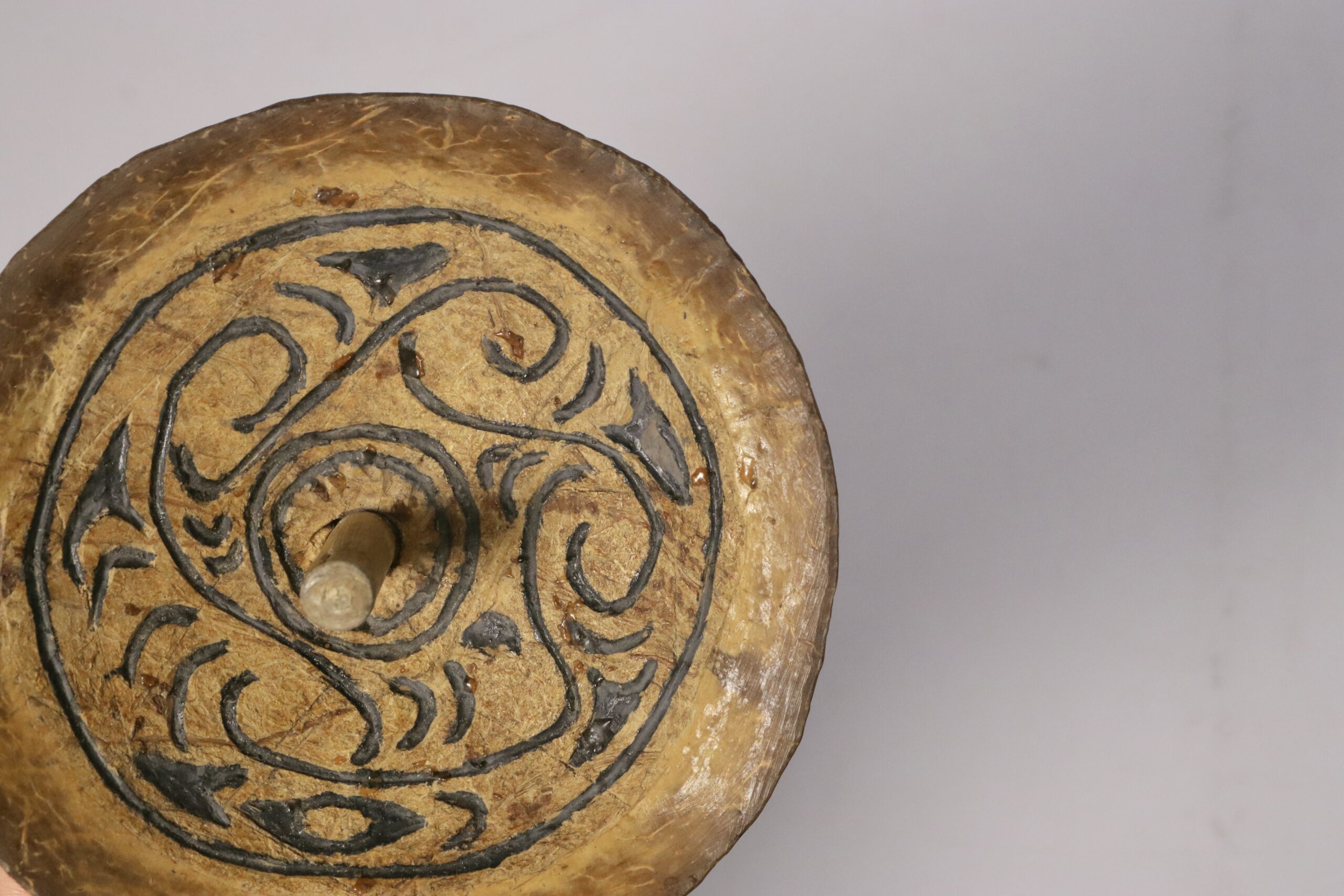
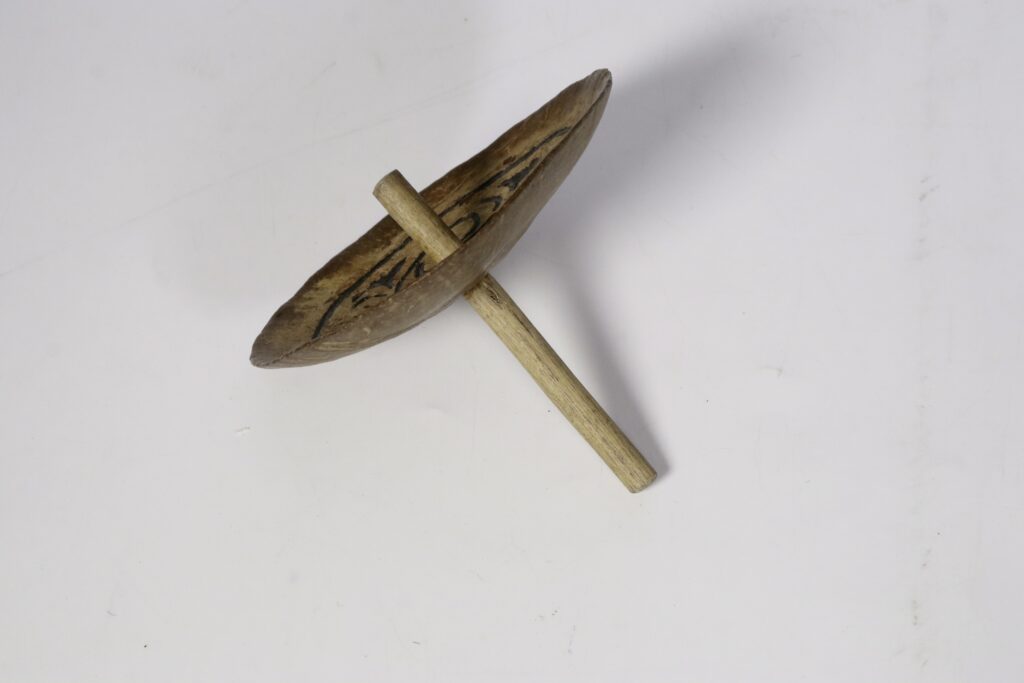
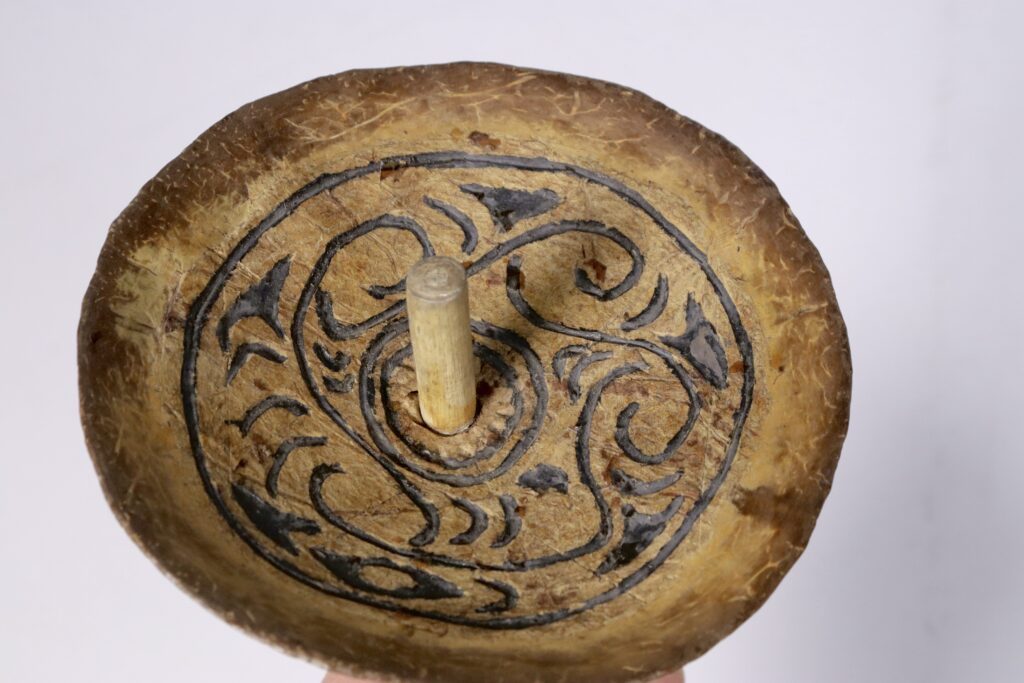
    A spinning top toy made from coconut and wood. The interior of the coconut (or Opi nut) has been scraped out to create a smooth surface, which has been carved and painted with ornament design etchings. A spindle protrudes through the middle of this inner side. Placing the toy object in one’s hands and pulling back in opposite directions allows the toy to spin on this spindle. 

    Function:  

    These spinning tops have been used across Papua New Guinea, but are particularly significant with the Elema, Abelam and Torres Straits communities. Top spinning is a toy or pastime for both children and adults. Two opponents (mostly boys and men) will ‘battle’ with these spinning tops by spinning the tops at each other, with the winning top remaining spinning and standing. These toys were also frequently used as a ceremonial game, where the winner was thought to have the biggest harvest that year. The toys often have designs etched into the inside of the top that are specific certain tribes or communities.  


    Dimensions:  15cm x 14 cm x 7 xm

    Materials:   Coconut, wood, likely paint or dye  

    Production Methods and Techniques:   Unknown, but spinning tops generally require wood carving processes.  

    Condition:  Good.   

    Name of Creator:   Unknown  

    Where the item was made:   Likely Papua New Guinea.  

    Date Made:  Unknown  

    Acquisition:  Unknown, but these objects were potentially acquired by Professor Hooshang Philsooph during his ethnographic research in Puang, West Sepik, Papua New Guinea and donated to the University of Edinburgh’s Social Anthropology Teaching Collection by him, where the Social Anthropology Department now has ownership. 

    Acquisition Date:  Unknown, but potentially acquired between 1971-1973 during Professor Hooshang Philsooph’s fieldwork.  

    Current Location:  Chrystal MacMillan Building in storage.   


    Sources:  

    Read, C.H. (1888) Stone Spinning Tops from Torres Straits, New Guinea. The Journal of the Anthropological Institute of Great Britain and Ireland, 17: 84-90. Doi: 10.2307/2841587.  

    Philsooph, H. (1980) A Study of a West Sepik People, New Guinea, with special reference to their system of beliefs, kinship and marriage, and principles of thought. PhD thesis. University of Edinburgh.  

    Recommended sites for further research:  To view similar objects, check the British Museum collection online, museum number: Oc,+.3435, and the Pitt Rivers museum collection online, database record 1931.86.156.    

    Name of Cataloguer:  Aisling Kelly  

    Date:  06/03/2025  

    Accession Number: SA028

  • Gongoli Mask

    Gongoli Mask

    Title:   Gongoli mask  

    Item Type:   wooden mask   

    Key words:  Gongoli, Kongoli, Mende, Sierra Leone, Kenneth Little, mask  

    Description:   

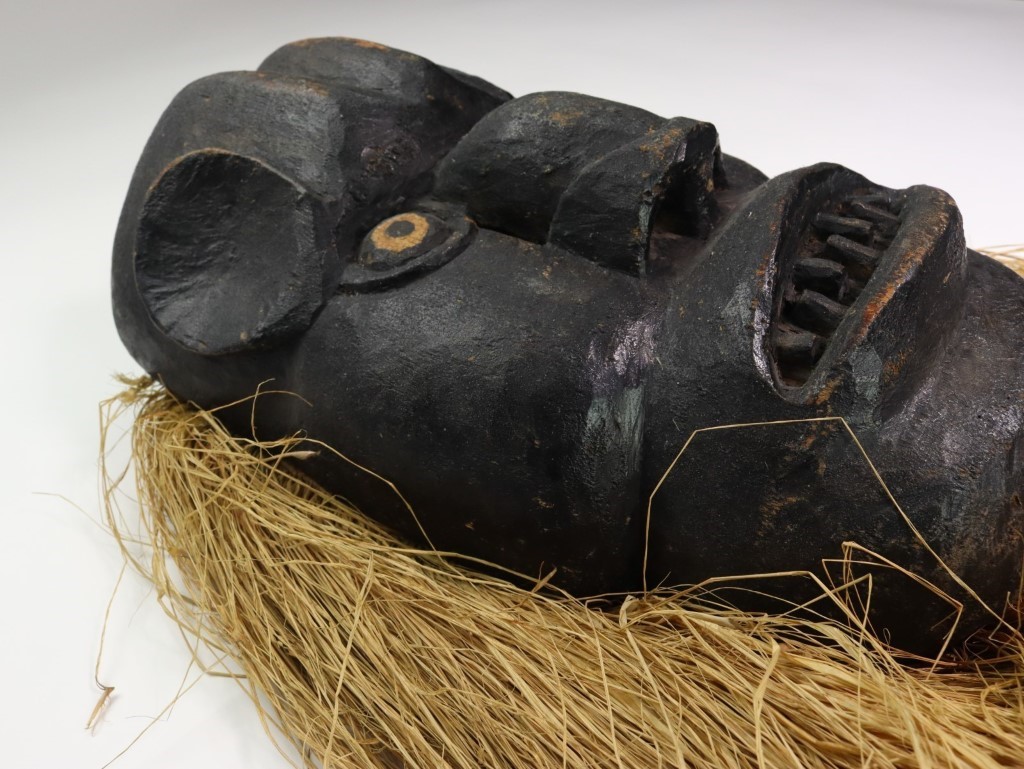
    A wooden gongoli/kongoli Mask with raffia organic fibres adjoined to the sides and extending down the mask’s face as fringing. The mask bears prominent teeth and lips, animal-like ears, round yellow eyes and a flattened nose. The nose has two hollow holes resembling nostrils which extend to the back of the mask.  

    Function:   

    In Mende society the gongoli/kongoli mask is referred to as the jester mask to provide comic relief during funerals or other serious masquerades/ceremonies. The masqueraders make fun of village elders or the chief and roll around on the ground acting silly. The function of the performance is to show the worst side of human nature: deformed, discheveled, chaotic, undisciplined, deceptive, and antisocial. The mask is worn with a costume of raffia and rags. The movements of the performer are disjointed, erratic, awkward, and amusing. Gongoli masks are usually owned by private individuals and may appear at any celebration.  

    Dimensions:   

    102cm x 38cm (mask and raffia)   

    Materials:   

    Wood, organic fibre (probably raffia, derived from the leaves of the raffia palm tree), black and yellow pigment   

    Production Methods and Techniques:

    We assume that wood carving and staining processes were used. Unlike the carving of other masks and “special” objects, in Mende society, carving gongoli masks is considered rough and any man is allowed to do it.     

    Condition:  

    Fair. The mask displays some discolouration, scratching and chips. The raffia is shedding.   

    Provenance

    Name of creator:  Unknown  

    Where the item was created/made: Sierra Leone    

    Date Made:  

    Unknown, but it is likely to have been made during or prior to the 1940s, when Kenneth Little performed his ethnographic fieldwork.  

    Acquisition:   

    We believe that the object was acquired by Professor Kenneth Little during his fieldwork in Sierra Leone. The object was brought to the University of Edinburgh and was donated to the Social Anthropology Teaching Collection. The nature of this acquisition is unknown.  

    Acquisition Date:

    It was likely acquired in the 1940s during Kenneth Little’s fieldwork in Sierra Leone. It was likely donated to the Social Anthropology Teaching Collection after Kenneth Little joined the University of Edinburgh in 1950.    

    Current Location:  5th floor of Chrystal MacMillan Building on display.   

    General Notesr:   

    Out of deference to his individualistic personality, the word Gongoli’ should be treated as a proper noun when referring to the character, although italicized it as a foreign word when it serves as an adjective or modifier (‘gongoli dancer’). The correct spelling of gongoli is open to some debate. Most Mende speakers and some academic texts insist on kɔnkɔli or kongoli, arguing that gongoli is a Krio deformation. I use gongoli in this text since I often refer to it as a pan-ethnic figure, the spelling is more familiar in the existing literature, and in spoken pronunciation the ‘k’s of kɔnkɔli are swallowed so that they are very close to ‘g’s (Anderson, 2018: 718).  .  

    Sources:  

    Anderson, S.M. (2018) ‘Letting the mask slip: the shameless fame of Sierra Leone’s Gongoli’, Africa, 88(4), pp. 718–743.

    Reinhart, L. (1975) ‘Mende Carvers’. PhD diss., Southern Illinois University Carbondale.  

    Name of Cataloguer:  Ariela Silber  

    Date:  05/03/2025    

    Accession Number: SA013  

  • Sowei Helmet Mask 

    Sowei Helmet Mask 

    This beautifully crafted wooden mask originates from West Africa and is adorned with intricate carvings and symbolic patterns. Tribal masks like this one are often used in ceremonial dances and rituals, representing deities, spirits, or ancestors. The detailed artistry reflects the cultural heritage and traditions of the region.

    Significance: Masks like this play a key role in storytelling, spirituality, and identity, offering insight into the values and beliefs of the communities that create and use them.

    Title: Sowei mask     

    Item Type:   helmet mask   

    Key WordsSowei, Bondu, Bundu, Mende, Sande, Sierra Leone, Kenneth Little, mask   

    Dimensions:   45cm x 23cm 

    Materials:   Wood and likely vegetable dye   


    Description:  

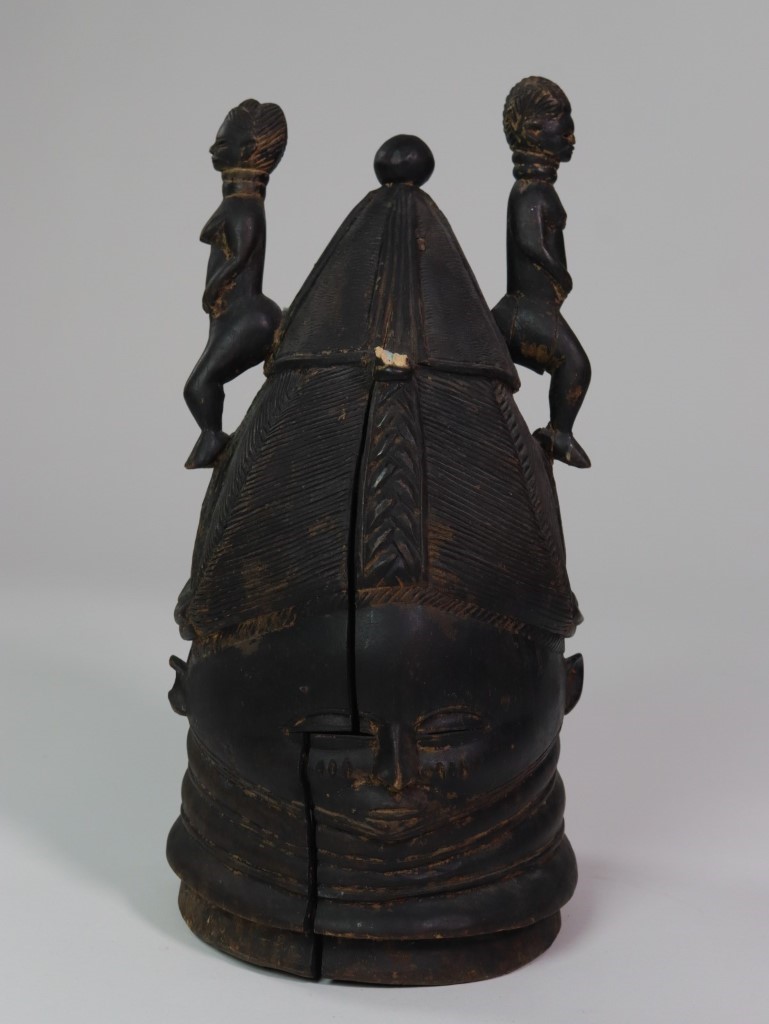
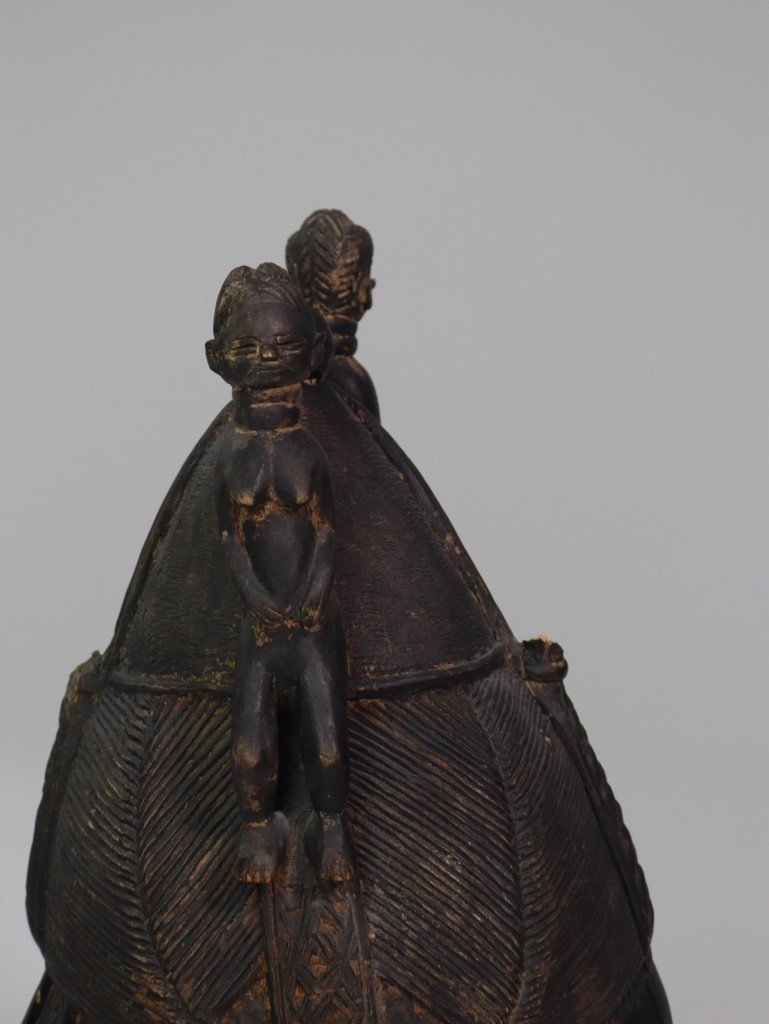
    A wooden helmet mask that is dyed black. It possesses neck rings, a detailed coiffure, downcast eyes and a composed facial expression that are typical of the sowei mask. This particular example has two female figures on either side of the head. The eyes have been made into slits and there are three scarification marks on each cheek. The hairstyle is engraved with zig-zag lines and two plaits at the front and back of the head. The hair meets as a ball on the top of the head. On the back of the head, there are nine flap-like forms, each engraved with varying patterns, that mark the base of the hairline.   

    Function:   

    Sowei masks are attributed to the Sande (also known as Bundu or Bondo), an all-female secret society in Sierra Leone, Liberia, Guinea and the Ivory Coast. The mask is worn during the end of girls’ initiation ceremonies when a ritual dance is performed by the society leader – the ndole jowei (dancing sowei). Usually worn with a raffia costume, the identity of the wearer is entirely concealed. It is believed that the sowei mask represents ideals of feminine beauty, with the full forehead representing wisdom and intellect, and the ringed neck embodying physical beauty in Mende society. This mask is likely a Mende sowei mask from Sierra Leone.   

    Production Methods and Techniques:

    Sowei masks are carved from a single piece of wood and hollowed out so it can fit over the wearer’s head. They are dyed with vegetable dye for a darker tint on the mask. Though sowei masks are exclusively worn by women in Mende society, they are carved by men. The carving of a sowei is considered a challenge in Mende society, due to the variance in carving and the special status attributed to the sowei masks. Each carver tends to have their own personal style, where they have the opportunity to demonstrate their artistic skill.   

    Condition:   

    Poor/damaged. There is extensive chipping and damage to the surface, although the black colour has been retained. Some pieces have broken off and been lost, including the leg of one of the female figures, part of the left ear and an attachment at the back. The piece broken off at the front of the mask has been retained as SA029.2. There is a vertical crack running across the face and through the left eye.  


    Provenance

    Name of creator:  Unknown   

    Where the item was created/made:Sierra Leone.  

    Date made:   

    Unknown, but it is likely to have been made during or prior to the 1940s, when Kenneth Little performed his ethnographic fieldwork in Sierra Leone.   

    Acquisition:

    It was likely acquired in the 1940s during Kenneth Little’s fieldwork in Sierra Leone. It was likely donated to the Social Anthropology Teaching Collection after Kenneth Little joined the University of Edinburgh in 1950.    

    Current Location: 5th floor of Chrystal MacMillan Building on display.   


    General Notes

    Sowei masks are given a name in Mende society, but we do not know the name of this specific mask.     

    Sources:  

    Little, K. L. (1949). ‘The Role of the Secret Society in Cultural Specialization.’ American Anthropologist, 51, no. 2: 199–212.  

    Otto, Kristin. (2020) ‘Creating the Sowei: Repairing and Interpreting Sowei Masks in Global Assemblages.’ Order No. 28027290, Indiana University.   

    Phillips, R. B. (1979) ‘The Sande Society Masks of the Mende of Sierra Leone.’ PhD diss., School of Oriental and African Studies, University of London.  

    Reinhardt, L. (1975) ‘Mende carvers’. PhD thesis, Southern Illinois University.   

    Recommended Sites for Further Research: Sierra Leone Heritage  

    Name of Cataloguer: Astrid Everall   

    Date: 06/03/2025  

    Acquisition Number: SA029

This website uses Google Analytics to gather usage statistics. Please accept or reject.

Cookie preferences