Welcome to the Social Anthropology Teaching Collection blog, where each artefact has its own story to tell. This collection is a window into the rich diversity of human cultures, showcasing objects from around the world that are steeped in history, tradition, and meaning.
From ceremonial masks and musical instruments to tools of survival and intricate textiles, these artefacts offer a glimpse into the practices, beliefs, and creativity of the communities that made and used them. Explore each post to uncover the fascinating cultural context and craftsmanship behind these remarkable pieces.
Join us on a journey to celebrate and learn from the traditions that connect us all.
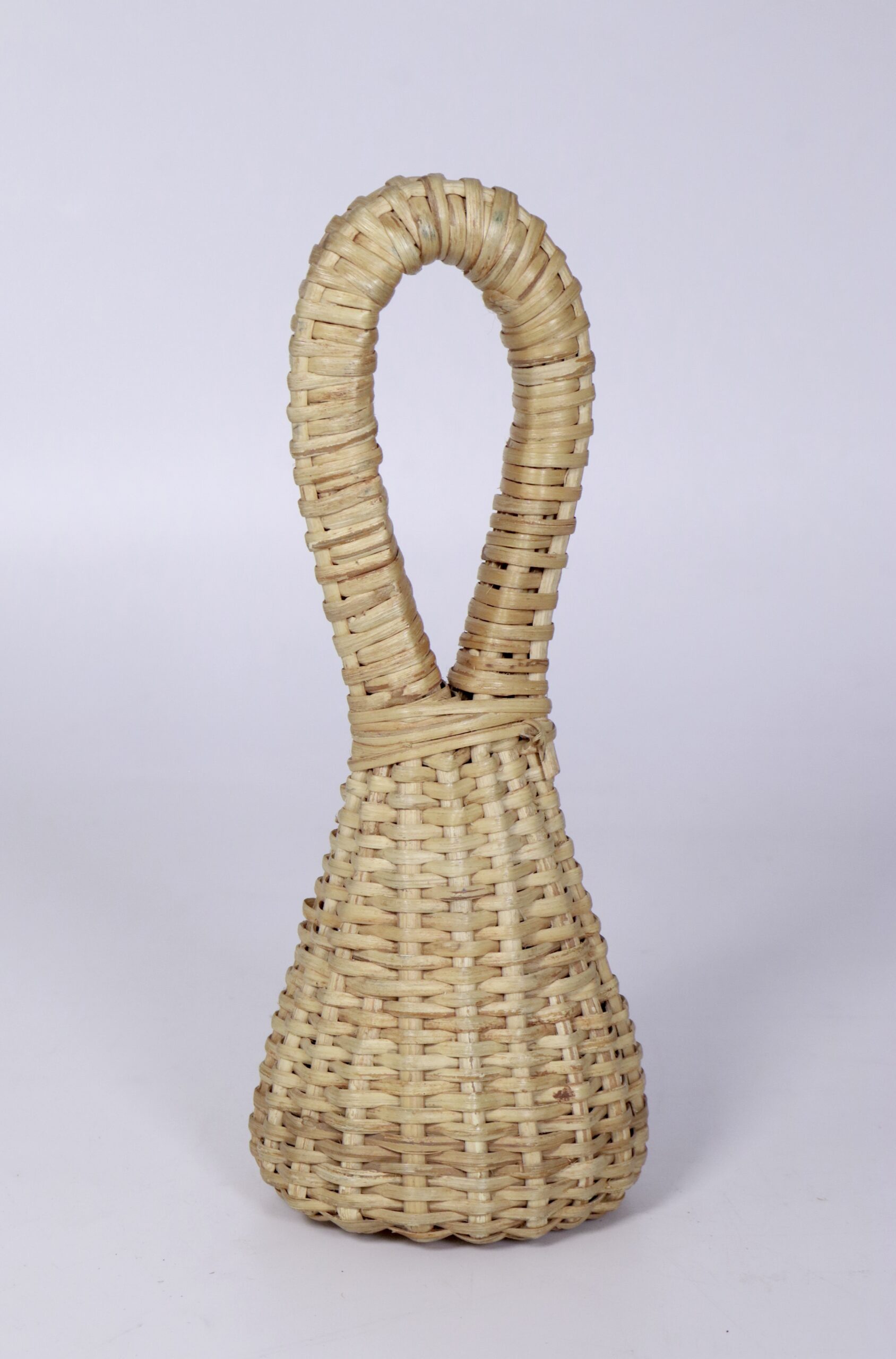
Square reed rattle consisting of 18 reed stalks divided by reed structure, encased in the middle are stones or seeds.
FUNCTION:
Musical instrument
DIMENSIONS:
15cm x 14.5cm
MATERIALS:
Seeds, Reed
PRODUCTION METHODS AND TECHNIQUES:
Unknown
CONDITION:
Good.
PROVENANCE:
NAME OF CREATOR:
Unknown, but it could potentially be associated with the Bamileke people due to labels from the Anthropology Teaching Collection.
WHERE THE ITEM WAS CREATED/MADE:
Unknown, but it could potentially be associated with the Cameroon grasslands region due to labels from the Anthropology Teaching Collection.
DATE MADE:
Unknown
ACQUISITION:
Unknown, but it was likely obtained by a PhD student of a member of staff at the University of Edinburgh during fieldwork and was then donated to the University of Edinburgh’s Social Anthropology Teaching Collection, where the Social Anthropology Department now has ownership. The nature of the acquisition is unknown.
Gourd rattle. Bulbous head with long handle. Head contains seeds or stones. Carved decoration on surface, including bird-like figures. Sellotape around the middle, added after acquisition and is indicative of outdated conservation and repair practices.
FUNCTION:
Musical instrument
DIMENSIONS:
30cm x 9cm
MATERIALS:
Seeds, gourd, string, sellotape
PRODUCTION METHODS AND TECHNIQUES:
Unknown
CONDITION:
Poor/Damaged
PROVENANCE:
NAME OF CREATOR:
Unknown, but it could potentially be associated with the Bamileke people due to labels from the Anthropology Teaching Collection.
WHERE THE ITEM WAS CREATED/MADE:
Unknown, but it could potentially be associated with the Cameroon grasslands region due to labels from the Anthropology Teaching Collection.
DATE MADE:
Unknown
ACQUISITION:
Unknown, but it was likely obtained by a PhD student of a member of staff at the University of Edinburgh during fieldwork and was then donated to the University of Edinburgh’s Social Anthropology Teaching Collection, where the Social Anthropology Department now has ownership. The nature of the acquisition is unknown.
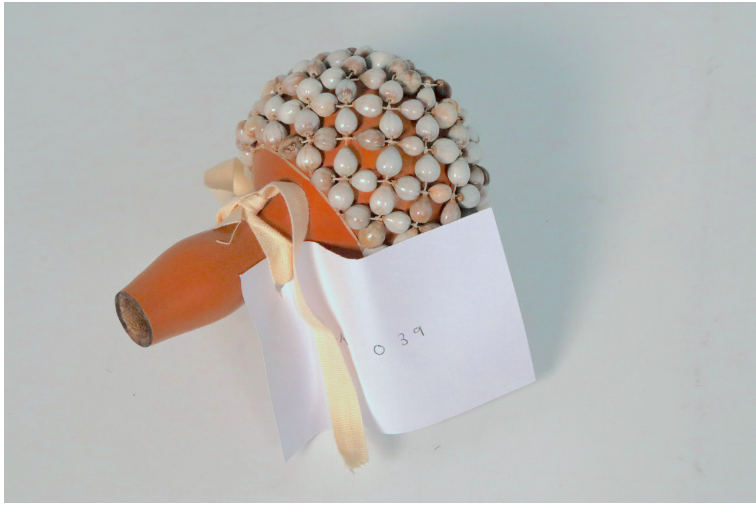
Small head of gourd covered by a string net woven with white/grey seed pods or small cowrie shells. The head of the rattle when shook produces the musical sound.
FUNCTION:
Musical instrument
DIMENSIONS:
13.5cm x 10cm
MATERIALS:
Seeds, gourd, string, cowrie shell
PRODUCTION METHODS AND TECHNIQUES:
Unknown
CONDITION:
Good.
PROVENANCE:
NAME OF CREATOR:
Unknown, but it could potentially be associated with the Bamileke people due to labels from the Anthropology Teaching Collection.
WHERE THE ITEM WAS CREATED/MADE:
Unknown, but it could potentially be associated with the Cameroon grasslands region due to labels from the Anthropology Teaching Collection.
DATE MADE:
Unknown
ACQUISITION:
Unknown, but it was likely obtained by a PhD student of a member of staff at the University of Edinburgh during fieldwork and was then donated to the University of Edinburgh’s Social Anthropology Teaching Collection, where the Social Anthropology Department now has ownership. The nature of the acquisition is unknown.
Woven grass rattle with a thick woven handle, string fortification at the base and a hollow, rounded head. The head of the rattle likely contains encased stones or seed that produces the musical sound.
FUNCTION:
Musical instrument
DIMENSIONS:
23cm x 8.5cm
MATERIALS:
Grass, string, likely stones or seeds
PRODUCTION METHODS AND TECHNIQUES:
Unknown
CONDITION:
Good.
PROVENANCE:
NAME OF CREATOR:
Unknown, but it could potentially be associated with the Bamileke people due to labels from the Anthropology Teaching Collection.
WHERE THE ITEM WAS CREATED/MADE:
Unknown, but it could potentially be associated with the Cameroon grasslands region due to labels from the Anthropology Teaching Collection.
DATE MADE:
Unknown
ACQUISITION:
Unknown, but it was likely obtained by a PhD student of a member of staff at the University of Edinburgh during fieldwork and was then donated to the University of Edinburgh’s Social Anthropology Teaching Collection, where the Social Anthropology Department now has ownership. The nature of the acquisition is unknown.
ACQUISITION DATE:
Unknown, but likely pre-1980s.
CURRENT LOCATION:
Chrystal Macmillan Building in storage.
AUDIO RECORDING OF RATTLE:
GENERAL NOTES:
SOURCES:
Schrag, B.E. (2005) How Bamiléké music-makers create culture in Cameroon. PhD thesis. University of California.
RECOMMENDED SITES FOR FURTHER RESEARCH:
OTHER ASSOCIATIONS:
There is a potential link to object SA040 and SA044 in the collection, as they could be from the same region and used in similar dances and performances, but this needs further researching.
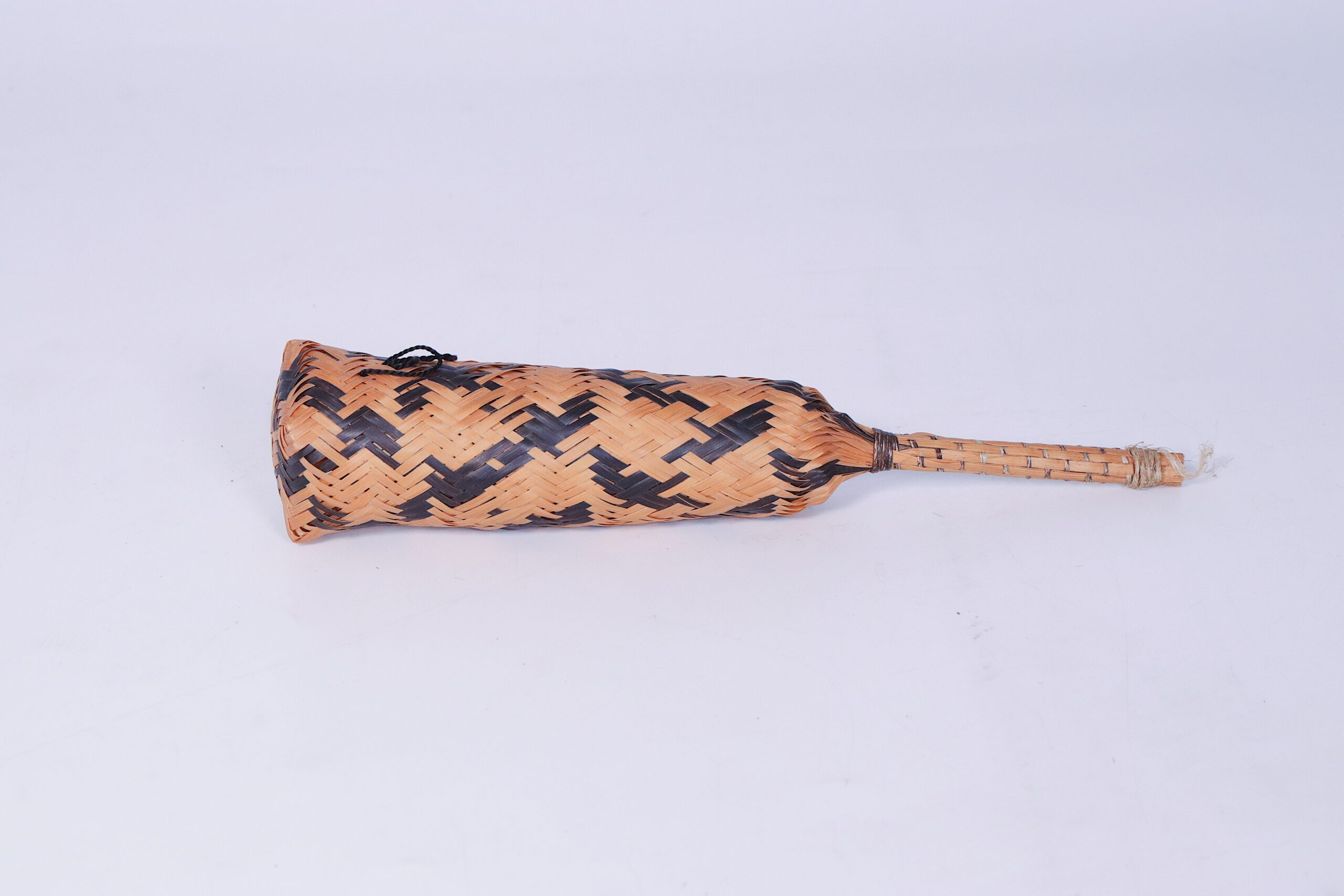
A brown and black plaited grass rattle with a long, thin handle and an oblong hollow head. The head of the rattle likely contains encased stones or seed that produces the musical sound.
FUNCTION:
Musical instrument
DIMENSIONS:
23cm x 4cm
MATERIALS:
Grass, string, likely seeds or stones
PRODUCTION METHODS AND TECHNIQUES:
Unknown
CONDITION:
Good.
PROVENANCE:
NAME OF CREATOR:
Unknown, but it could potentially be associated with the Bamileke people due to labels from the Anthropology Teaching Collection.
WHERE THE ITEM WAS CREATED/MADE:
Unknown, but it could potentially be associated with the Cameroon grasslands region due to labels from the Anthropology Teaching Collection.
DATE MADE:
Unknown
ACQUISITION:
Unknown, but it was likely obtained by a PhD student of a member of staff at the University of Edinburgh during fieldwork and was then donated to the University of Edinburgh’s Social Anthropology Teaching Collection, where the Social Anthropology Department now has ownership. The nature of the acquisition is unknown.
ACQUISITION DATE:
Unknown, but likely pre-1980s.
AUDIO RECORDING OF RATTLE:
CURRENT LOCATION:
Chrystal Macmillan Building in storage.
GENERAL NOTES:
SOURCES:
Schrag, B.E. (2005) How Bamiléké music-makers create culture in Cameroon. PhD thesis. University of California.
RECOMMENDED SITES FOR FURTHER RESEARCH:
OTHER ASSOCIATIONS:
There is a potential link to object SA040 and SA045 in the collection, as they could be from the same region and used in similar dances and performances but this needs further researching.
Shell rings (takei), embroidery string (pirik), fibrous sheet (potentially made of barkcloth or coconut palm tissue) and rattan cords
Production Methods and Techniques: Unknown, but likely embroidery techniques.
Condition: Good.
Description:
Headdress made from fibrous sheet that is embroidered with shell rings, with circular patterns in the centre and tapered ends. A cord is attached to either side of the sheet, which presumably is used to tie to head. This item was previously catalogued as a belt but we believe it is more likely to be a headdress.
This vibrant ceremonial textile, woven with intricate embroidery, comes from Southeast Asia. The fabric is decorated with bright colors, geometric patterns, and symbolic motifs, often representing spiritual or social themes.
Significance:
Ceremonial textiles serve both functional and symbolic purposes, used in celebrations, rituals, and as markers of social status or cultural identity.
Function:
In Puang communities, suwau is part of the bride-wealth and used in land buying or exchanged in peace-making rituals, post warfare.
Provenance
Name of Creator: Unknown
Where the item was created/made: Likely Papua New Guinea.
Date Made: Unknown
Acquisition:
Unknown, but these objects were potentially acquired by Professor Hooshang Philsooph during his ethnographic research in Puang, West Sepik, Papua New Guinea and donated to the University of Edinburgh’s Social Anthropology Teaching Collection by him, where the Social Anthropology Department now has ownership.
Acquisition date:
Unknown, but potentially acquired between 1971-1973 during Professor Hooshang Philsooph’s fieldwork.
Current Location: Chrystal Macmillan Building in storage.
General Notes
Sources:
Philosooph, H. (1980) A Study of a West Sepik People, New Guinea, with special reference to their system of beliefs, kinship and marriage, and principles of thought. PhD thesis. University of Edinburgh.
Key Words: Puang, Papua New Guinea, shells, Hooshang Philsooph
Description:
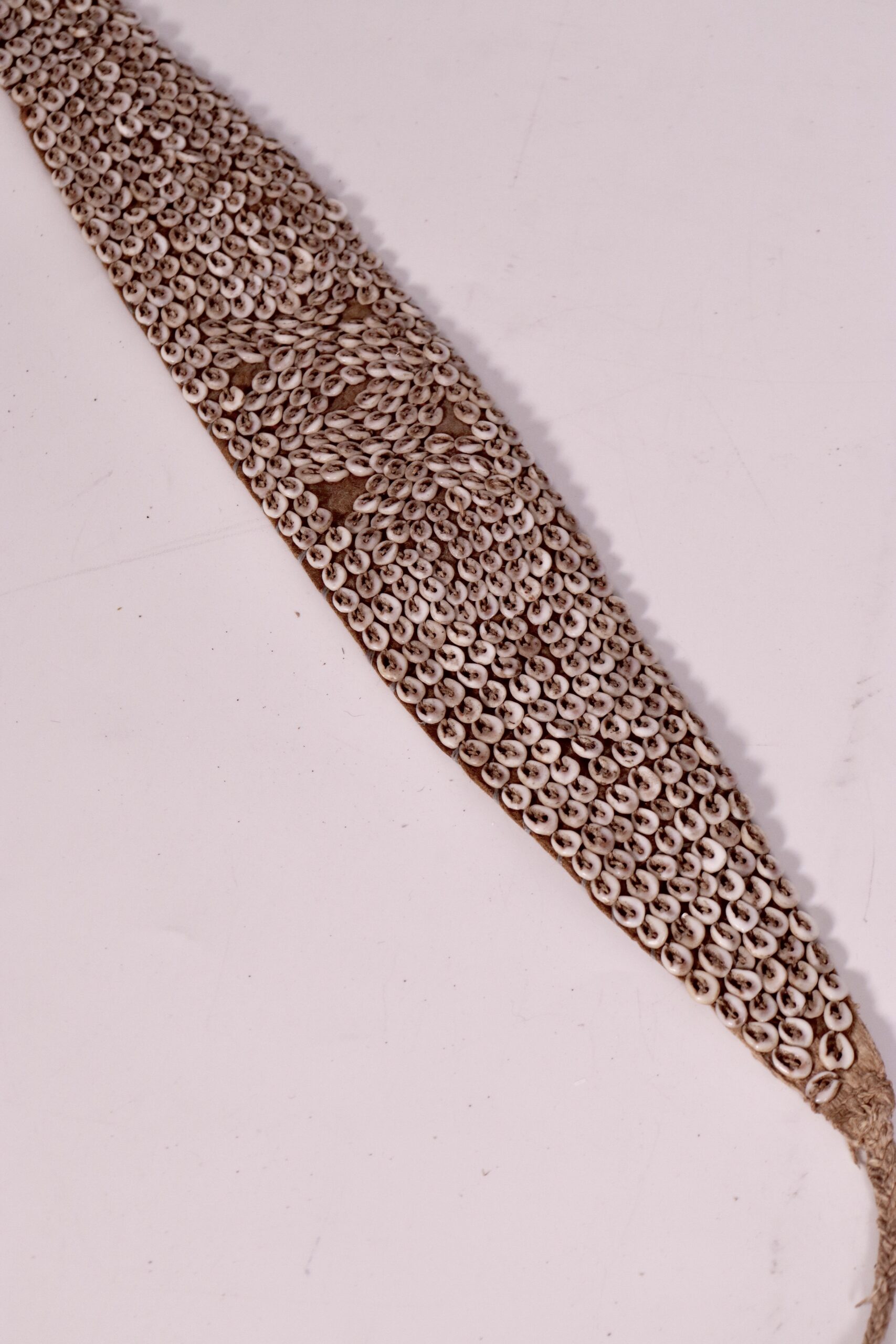
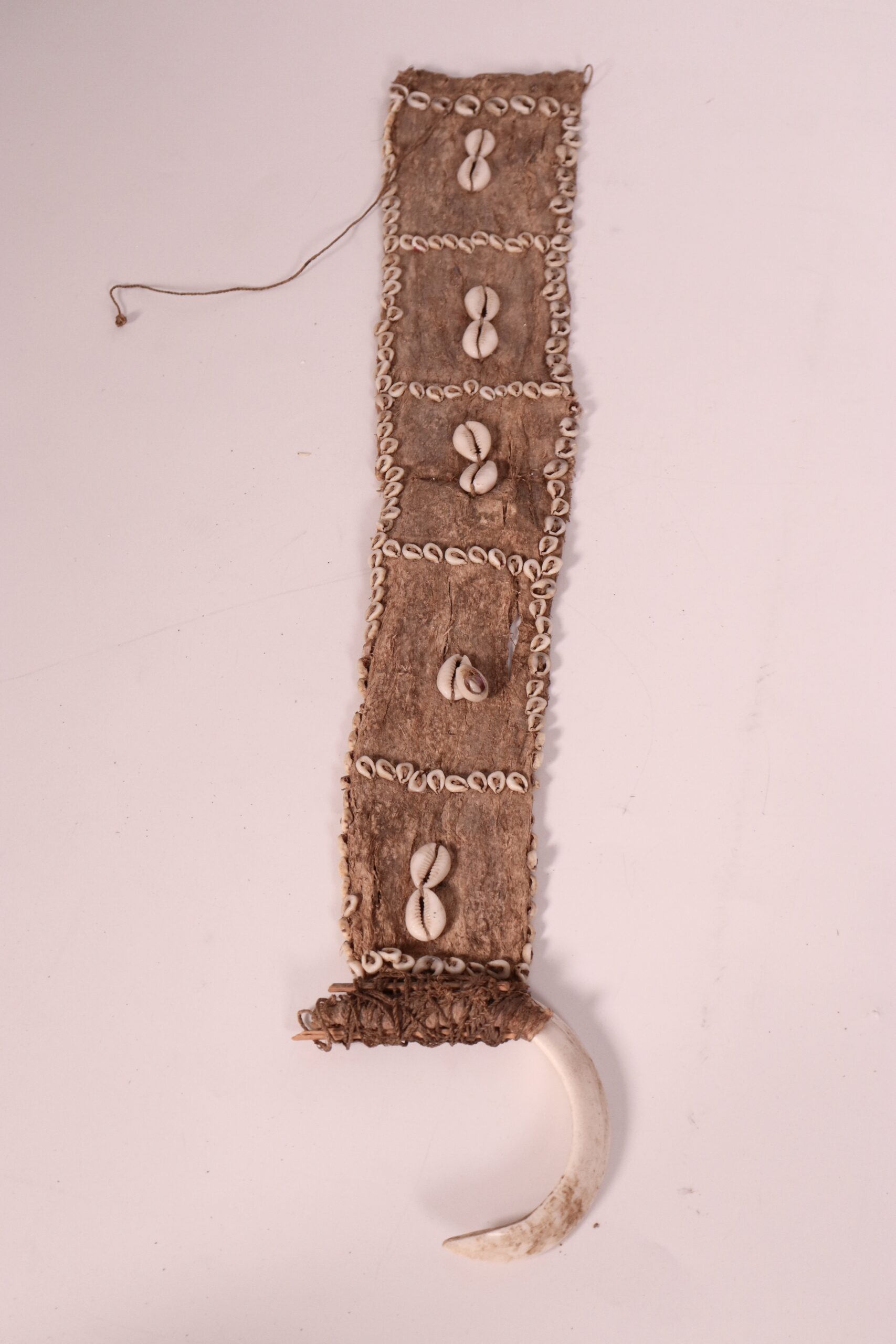
Rectangular fibrous sheet embrodiered with shell rings around the edges and in a square pattern. There are two whole cowrie shells in the centre of each square. At one end of the sheet, a curved tusk is attached with string. The back of the sheet is dyed with red and black pigment in a pattern.
Function:
Unknown, but it could possibly be used as a belt or a hanging ornament.
Dimensions: 45cm x 9cm
Materials:
Shell rings (takei), whole cowrie shells, embroidery string (pirik), fibrous sheet (potentially made of bark or coconut palm tissue), red and black pigment, tusk
Production Methods and Techniques:
Unknown, but likely embroidery techniques.
Condition:
Poor/damaged. There are visible signs of wear to the object and some small tears.
Provenance
Name of Creator: Unknown
Where the Item was created/made: Likely Papua New Guinea.
Date Made: Unknown
Acquisition:
Unknown, but these objects were potentially acquired by Professor Hooshang Philsooph during his ethnographic research in Puang, West Sepik, Papua New Guinea and donated to the University of Edinburgh’s Social Anthropology Teaching Collection by him, where the Social Anthropology Department now has ownership.
Acquisition Date:
Unknown, but potentially acquired between 1971-1973 during Professor Hooshang Philsooph’s fieldwork.
Current Location:
Chrystal Macmillan Building in storage.
General Notes
Sources:
Philosooph, H. (1980) A Study of a West Sepik People, New Guinea, with special reference to their system of beliefs, kinship and marriage, and principles of thought. PhD thesis. University of Edinburgh.
Other associations: There is a likely association with object SA04.
Name of Cataloguer: Astrid Everall and Ariela Silber
Materials: Wood (likely betel nut), feathers (either lory, cockatoo or parrot), breadfruit tree saps, bamboo ashes, paint (made from Hapin)
Production Methods and Techniques: Unknown, but likely carving and cord plaiting processes were used.
Condition: Good
Description
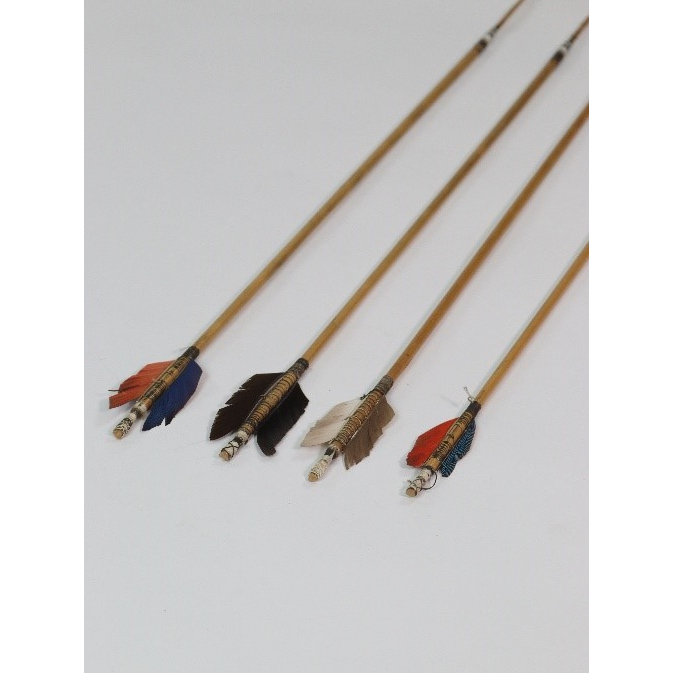
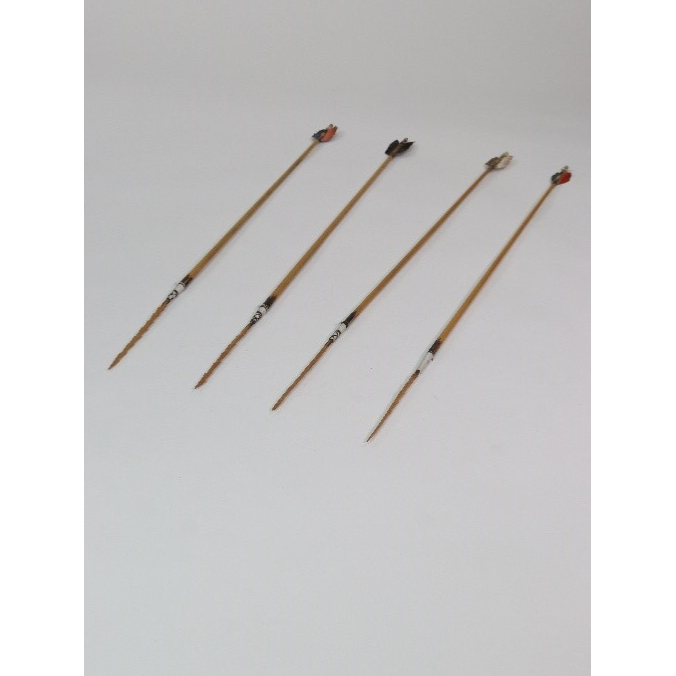
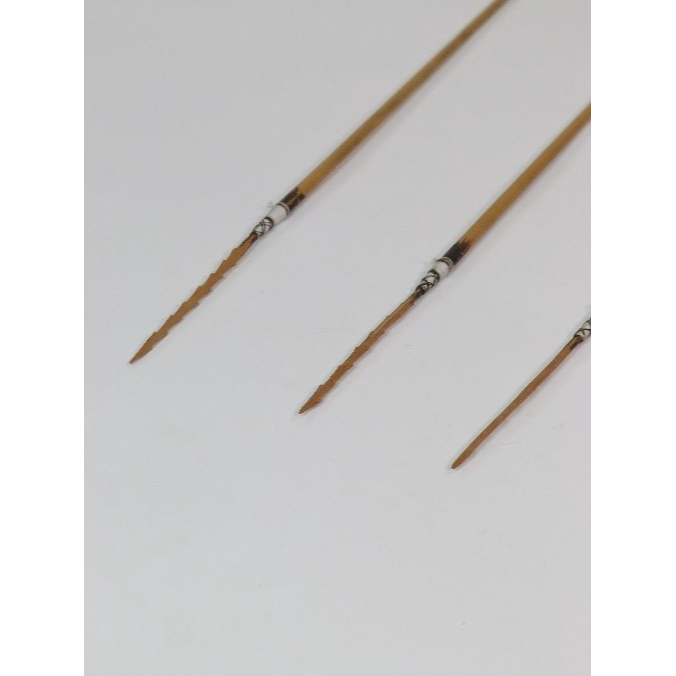
Four barbed betel nut wood-made arrows with multi-coloured feathers (these objects were previously categorised as spears but after research was undertaken, we have since distinguished them as arrows). These Yayrapen have barbed arrowheads with sharpened tips. Black and white threads and black paint decorate and secure the arrow hafting. The arrow shafts are a light brown wood, straight and smooth to touch. The fletchling are made with multi-coloured feathers fastened by black and white twine threads (two are red and blue, one is dark brown and one is beige and light brown). Black and white threats plait around the nock of the arrow, displaying visible arrow dents.
Function:
Yayrapen is a type of arrow mainly used by the Puang people from Papua New Guinea. They are used to injure or possibly kill men, and to hunt pigs and cassowaries. The shapes and uses of these arrows are related to Puang people’s ‘destructive magic’: to diminish or hurt enemies’ souls, indigenous magicians will make different ‘magical bundles’ that resemble these arrows to curse their counterparts. This relates to a basic perspective in Puang warfare that drawing enemies’ blood can sometimes be more important that killing the enemy, as personal belongings (or blood) can be used in ‘destructive magic’ to harm their souls. It is notable that the term Yayrapen is not the overall name for all Puang magical arrows, but only refers to one kind of arrow, amidst other Puang weaponry used for purposes of ‘destructive magic’.
Provenance
Name of creator: Unknown
Where was the Item created/made: Unknown, but likely Papua New Guinea.
Date Made: Unknown
Acquisition:
Unknown, but these objects were potentially acquired by Professor Hooshang Philsooph during his ethnographic research in Puang, West Sepik, Papua New Guinea and donated to the University of Edinburgh’s Social Anthropology Teaching Collection by him, where the Social Anthropology Department now has ownership.
Acquisition Date:
Unknown, but potentially acquired between 1971-1973 during Professor Hooshang Philsooph’s fieldwork.
Current Location: 5th floor of Chrystal MacMillan Building on display.
General Notes
Sources:
Philosooph, H. (1980) A Study of a West Sepik People, New Guinea, with special reference to their system of beliefs, kinship and marriage, and principles of thought. PhD thesis. University of Edinburgh.
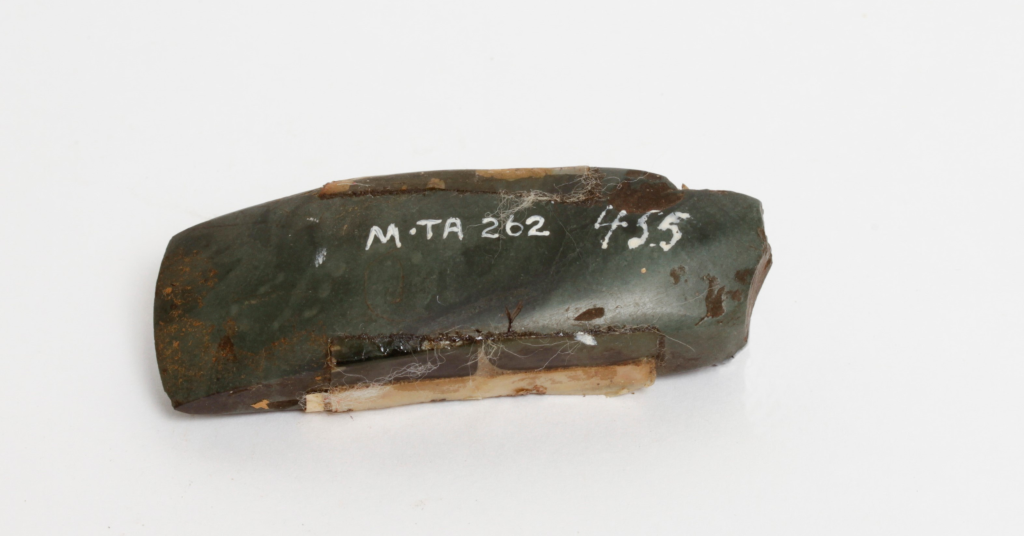
Key Words: Adze, greenstone, blade, Massim, Papua New Guinea, weaponry
Dimensions: 9cm x 18cm
Materials: Chloromelanite stone
Condition: Fair. The blade has several scratches and dents around its rim.
Description:
A carved green stone. This stone is likely to be the blade of a ceremonial axe, an adze blade, from the Massim regions of Papua New Guinea. The axe blade is inserted into a wooden handle that is shaped like a slightly tilted 7 and fastened into the handle by wrapped fibres that hold the blade in place.
Function:
As a prestige item, adze blades were carried or worn in the belt for adornment on special occasions such as sing-sing and moka exchanges. Due to the risk of breaking the thin blade, they were only used for cutting off fingers as a sign of grief and sometimes in close combat. They were also used as money to buy other commodities, such as salt, body oil, shells and brides. The axes were used ceremonially as ‘strength-giving ornaments’ in the ceremonial dances during the Konggol. The wooden handles that hold the stone are only temporary supports for the blade, carved especially to carry and display the stone during exchange ceremonies. Once it has been inserted in the haft, the stone blade is marked for presentation and exchanged, after which the handle is often discarded until the next exchange cycle demands that a new one be carved.
Indigenous Massim people would use stone axes and tools until colonists from Australia introduced steel tool in the mid-20th century, however, it is suggested that the polished axe stones maintained their value as ceremonial valuables that were traded between communities. The axes that are created today are identical to those made in the past, except that most of the stone used now is softer and more fragile as it is easier and quicker to work with.
Production Methods and Techniques:
It is suggested that these stones were quarried from a cave in the volcanic regions of the Massim Islands in Papua New Guinea. Cracks are produced in the solid rock, partly by hammering it with wooden billets and partly by alternately heating it with fire and pouring cold water on it. Next, wedges were forced into the cracks and blocks broken free. Archaeological evidence points to a long-extinct greenstone tool industry centered around the quarry of the Suloga hills in Muyuw (Woodlark Island).
Provenance
Name of Creator: Unknown
Where the Item was created/made:
Likely the Southern Isles of Papua New Guinea
Date Made: Unknown
Acquisition:
Unknown, but it was likely obtained by a PhD student of a member of staff at the University of Edinburgh during fieldwork and was then donated to the University of Edinburgh’s Social Anthropology Teaching Collection, where the Social Anthropology Department now has ownership. The nature of the acquisition is unknown.
Acquisition Date: Unknown
Current Location: 5th floor of Chrystal MacMillan Building on display.
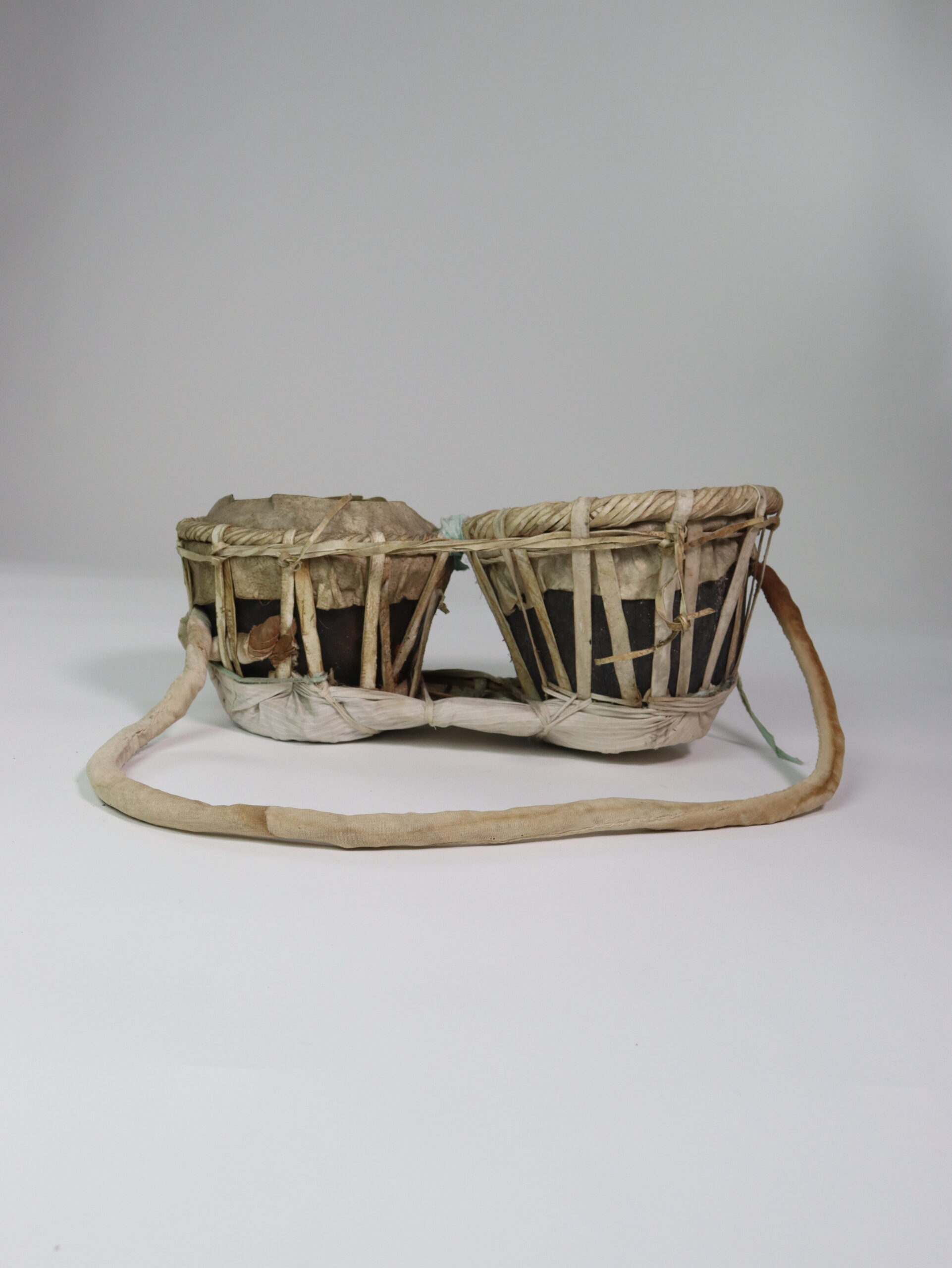
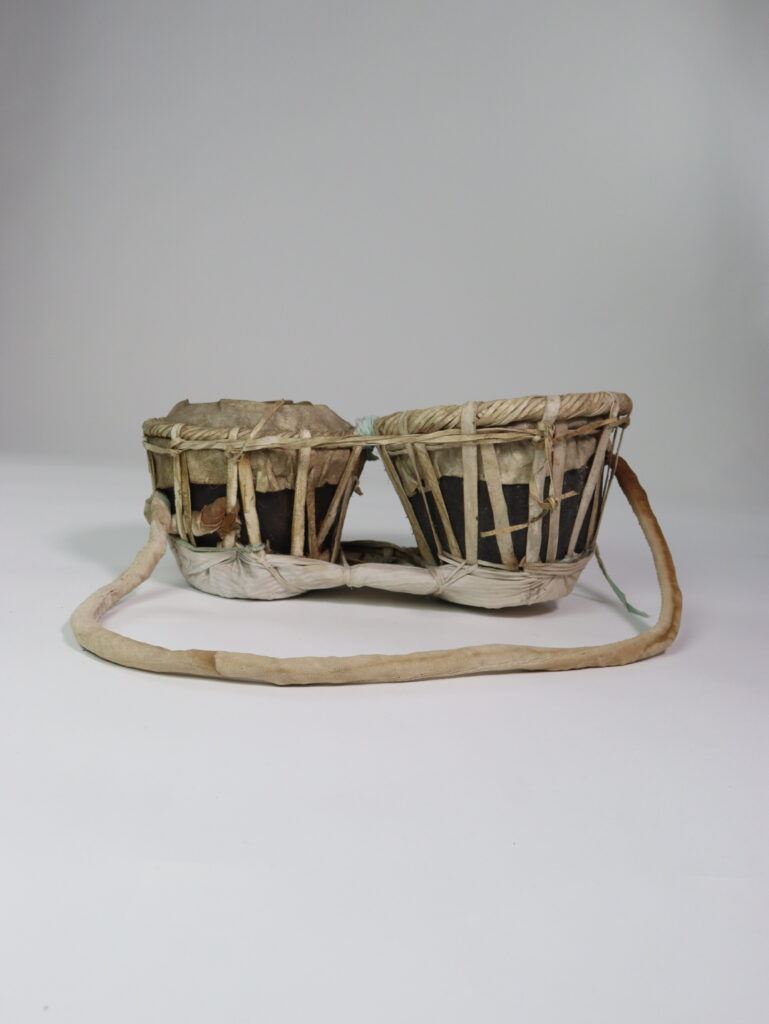
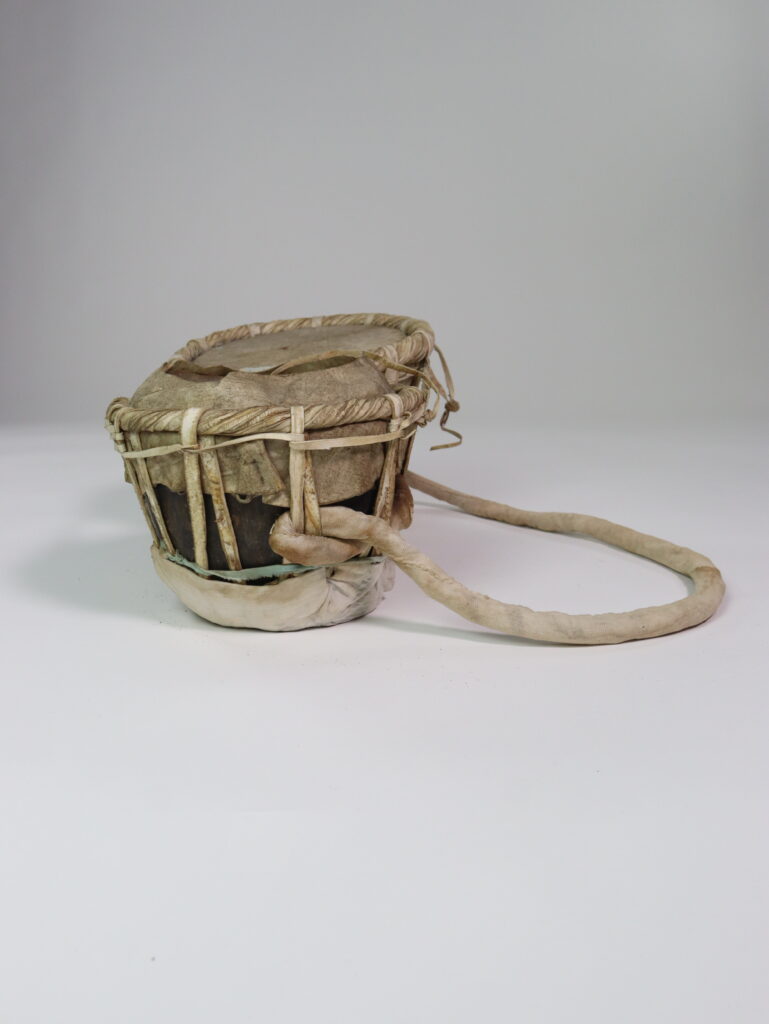
Key Words: Thammattama, bongo drum, drum, Sinhalese, Sri Lanka, musical instrument, Anthony Good
Materials: Wood (possibly from Kohomba, Ehela and Jak trees), animal skin/fibres, cotton
Dimensions: 40cm x 20cm
Description:
Bongo drums with a neck strap. The two wooden bowls of the drum are connected by strips of skin and two wooden rods on the sides. The membranes are held by a band of twisted fibres that encase the edge of the drums and are connected to a second fibre on the underside of the drum with ten vertical strips of skin. A thick fibre band (urapota) wrapped in cotton fabric is tied to the skin strips on both outer sides, forming the drum strap.
Function:
The Thammattama Bera consists of two parts, with high sounds produced by the right drum and low sounds produced by the left drum. It is played with two sticks with circular ends rather than with hands. Thammattama is generally not played with equal pressure. There are special rhythms played on this drum used in Buddhist processions, to invite people into the temple, invite Buddhist priests for Pirith ceremonies or for alms giving. In Buddhist processions, the players move in fixed steps to the constantly repeated basic beat of their drums, which is beaten with the left hand, while the right hand adds complicated rhythmic variations. Occasionally, the players use their forearms and elbows as an artistic element in addition to the sticks. In conjunction with the Dawula, the Thammattama fills out the rhythmic cycle set by the cylinder drum.
The Thammattama holds significance in Sinhalese society, where, during the times of the Sinhalese kingdoms, Bera were used to announce official decrees and the army marched into battle with war drums (Rana Bera).
Production Methods and Techniques:
It is usual to have a ceremony to begin the production of the Thammatta Bera. However, due to increased commercialisation in regions where these drums are made, it is possible that these ceremonies are ignored.
Condition:
Fair. There are signs of wear to the bounded fibres and cotton. The two circular bound sticks that are used to play the Bera are missing from the one in our collection.
Provenance
Name of creator: Unknown
Where the item was created/made: Unknown, but likely Sri Lanka
Date Made: Unknown
Acquisition Date: Unknown, but likely pre-1980s.
Current Location: 5th floor of Chrystal MacMillan Building on display.
Acquisition:
This object was possibly acquired by Professor Emeritus Anthony Good during his ethnographic fieldwork in Sri Lanka and then donated to the University of Edinburgh’s Anthropology Teaching Collection by him, where the Social Anthropology Department now has ownership. The nature of this acquisition is unknown.
Name of Cataloguer: Ariela Silber
Date: 05/03/2025
Assession Number: SA035
This website uses Google Analytics to gather usage statistics. Please accept or reject.