Category: Student blog

A place for the students to blog on their reflections of this project.

  • Annabel’s Reflection

    Throughout the years of my undergraduate degree in Social Anthropology, I have always been aware of a stark divide that has influenced our scholarly curriculum; that between the symbolic and the physical worlds. In my academic journey over the years, it has always felt as though our educational institutions remain tethered to pedagogical frameworks that privilege sight over touch, epitomised by the cautionary refrain: ‘You can look, but you can’t touch.‘ And this becomes applicable to my young childhood experiences visiting museums and exhibitions across Scotland, where I was perpetually positioned as a distant observer, separated from historical artefacts by impenetrable barriers and clinical glass enclosures. 

    And of course, there are obvious rationales that could indicate why young children should not run their hands down the skeleton of a Diplodocus which is millions of years old at the Kelvin Grove Art Gallery. However, in relation to slightly less radical circumstances, I have always wondered what is left unseen in this systematic physical distancing between human subjects and material objects. What essential dimensions of understanding become obscured, suppressed, or entirely lost? How do these institutionalised boundaries of engagement fundamentally alter our epistemological relationship with material culture? 

    Having had the privilege to engage with the Anthropology Teaching Collection over the course of this project, I can conclude that none of the above questions can satisfyingly be answered. The artefacts that we held in the palms of our hands mirror a legacy of dispossession and imperial negligence at this institution of further education and with that emerges a series of forgotten stories and contested pasts that may not ever be recovered. Our experience of object-based learning thus becomes intricately entangled in a complex web of decolonial scholarship, revealing the power dynamics and hierarchies of touch that undergird elite educational institutions. These objects are not neutral; they are charged with unspoken narratives of extraction, appropriation, and systemic erasure -speaking volumes about the violent histories of knowledge production and the continued mechanisms of cultural loss that the University of Edinburgh is accountable for.  

    It can then only be assumed that overwhelming emotions of guilt and disturbance have filtered my learning experience in this way and handling these valuable artefacts has never felt comfortable, has never felt okay. However, in my (still) limited knowledge about the artefacts, touching them has catalysed a connectedness that I have rarely felt over the trajectory of my academic career. And this has been the most poignant learning experince I have witness across this course. I feel as though I have been granted the opportunity to be held responsible for something that falls outside of the jurisdiction of a gradebook; to care

    With this I realise that in our current educational landscape, caring has become a radical act. We’re trained to consume information, to memorise, to perform – but rarely to feel, to connect, to understand deeply. By systematically removing tactile, emotional engagement from our curricula, we’re producing a generation of learners disconnected from the very histories and material worlds that shape our present. Academic engagement across the humanities has become confined to theoretical and scholarly understanding and removed from our human experiences. And this becomes particularly prevalent in relation to the precarious political climate that threatens the world currently. We’re teaching students to observe, but not to feel. To analyse, but not to empathise. To engage but not to act.  

  • Basic Features and Potential Problems in Contemporary and Digital Cataloguing 

    Basic Features and Potential Problems in Contemporary and Digital Cataloguing 

    by Yiyang Wen

    The fundamental reason people want to catalogue and preserve heritage derives from modernists’ anxieties for the loss of the past, while ironically the loss of the past until recently is still the basic feature of the present. This implicates an ideal expectation that catalogue can traverse time and space to record object in its full details. However, this wish fails because nothing can spatiotemporally persist. This tension, to my perspective, endows contemporary cataloguing with three controversial features. 

    First, cataloguing is never neutral because objects are described differently through different times and spaces. As some scholars suggest, object preservations and cataloguing are always under certain socioeconomic environments that implicate dominantly political schema. Cataloguers, even if being told to be “neutral and fair”, can never achieve that idea because they live in this politicised world. For example, previous British cataloguers interpret objects from Maqdala, Ethiopia as “looted treasures” while contemporary ones are more drawing on objects’ provenance and traditional aspects. Here, catalogues from different times have very different explanations about the same collection. 

    Second, cataloguing inherits personal traits from corresponding cataloguers. This is to say, “who to catalogue what?” is a core question embedded in contemporary cataloguing world. An example in digital catalogues can better explain this. While previous cataloguers considered their data as valuable and accessible, later cataloguers who needed to transit all information from physical paperwork to digital database would treat some seemingly redundant labels and descriptions as “dirty data” that should be cut off. This situation is prominent because we can imagine how much data has been manually omitted by certain righteous reasons from cataloguers at that time. 

    Third, cataloguing is a way to dominate rights to access and interpret knowledge. In other words, objects are described by those who are eligible to describe them. This shows a sheer unbalanced power relation between the dominant and the underprivileged. To the best, cataloguers can “collaborate” with indigenous people on object interpretations, while to the worst, cataloguers exert “violence” on object alone that detach it from its ethnographic backgrounds. Watkins and the Black Bottom Archive did a great job in “collaboration”, in that they engaged with Black Detroit Community and tried to explore personal histories that were related to their archival objects. 

    In addition to these three basic features and corresponding problems, the rise of digital cataloguing also brings two difficulties. For one, for the sake of fast searching database, digital catalogue is seemingly monopolising knowledge, especially those key words from only cataloguer sides to describe objects; for another, the transition from physical documents to digital catalogues inconveniently requires cataloguers to have professions in both areas, because they need to understand why some information is important while others are not. 

    Reference 

    Arizpe, L. and Amescua, C. (eds) (2013) Anthropological Perspectives on Intangible Cultural Heritage. Heidelberg: Springer International Publishing (SpringerBriefs in Environment, Security, Development and Peace). Available at: https://doi.org/10.1007/978-3-319-00855-4. 

    Brulon Soares, B. and Witcomb, A. (2022) ‘Editorial: Towards Decolonisation’, Museum International, 74(3–4), p. 1. Available at: https://doi.org/10.1080/13500775.2022.2234187. 

    Prosper, S. (2024) ‘A failure of care: unsettling traditional archival practices’, in C. Krmpotich and A. Stevenson (eds) Collections Management as Critical Museum Practice. UCL Press, pp. 35–48. Available at: https://doi.org/10.2307/jj.19551243.7. 

    Turner, H. (2020) ‘Object, Specimen, Data: Computerization and the Legacy of Dirty Data’, in Cataloguing Culture. University of British Columbia Press, pp. 157–183. Available at: https://doi.org/10.59962/9780774863940-009. 

  • Zahra’s reflection

    Zahra’s reflection

    By Zahra Abdalla  

    My first essay for the Anthropology in Practice course was centered on using the stolen jewels of Queen Amanishaketo as a case study into the role of Western museums in perpetuating and sustaining colonial violence, discussing the agency and afterlife of objects. Drawing on post-colonial theories like Ngūgī wa Thiong’o’s (1986) idea of the ‘cultural bomb’ as an imperial tool obliterating people’s belief in their heritage (amongst many other things) and the Fanonian principle that violence orders the colonial world destroying multiple aspects of life for the colonized (Fanon,1963); I saw that the presence of Amanishaketo’s jewels in Western museums given the colonial history of Sudan built on Classen and Howes’ argument that ‘Collecting is a form of conquest and collected artifacts are material signs of victory over their former owners and places of origin.’(2006,209).

    The presence of Kushite artifacts within Ancient Egyptian museums in the museum space reflected and sustained a wider narrative and hierarchy relating to African artefacts, and diminished the cultural value ascribed to the jewels of Amanishaketo and the wider character of the Kushite queen (Kandaka) in contemporary Sudanese society, and the repercussions of the treatment of these objects in Western museums, directly affecting their agency and afterlife. However, acknowledging the current political situation in Sudan, I recognised that the path to repatriation was less straightforward, and this project working with the Social Anthropology Teaching Collection revealed the nuances and subtleties in the ongoing conversations surrounding repatriation.

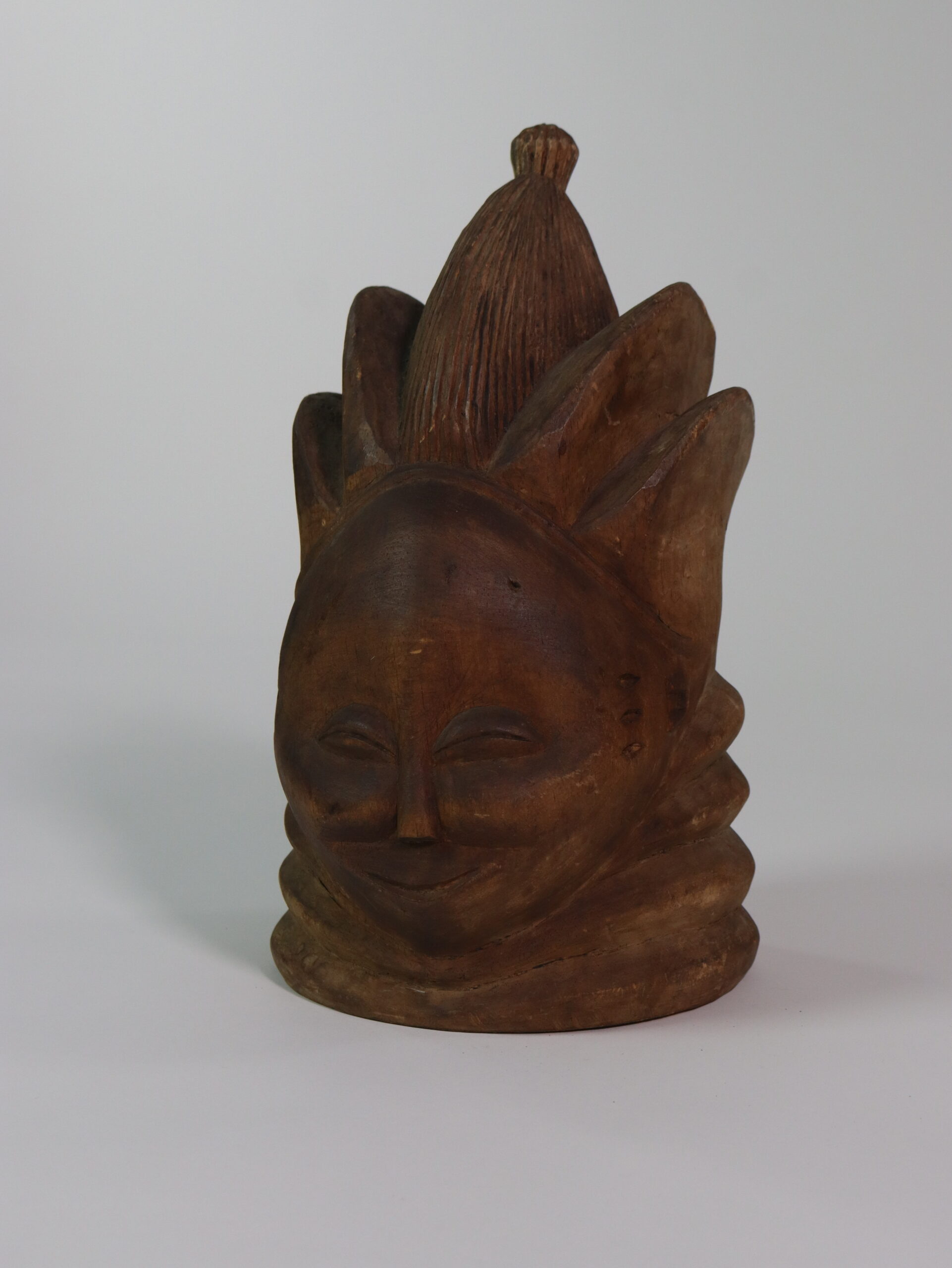
    Working with the Sierra Leonean Sowei masks in the Collection unearthed the complexities of repatriation, given the difficulties of provenance work. I began to understand these complexities more wholly though Paul Basu’s work on Sierra Leonean collections in the museumscape, considering ‘flows of cultural capital, the question is whether such collections might play a more valuable role in Sierra Leone’s postconflict rehabilitation from their diasporic locations than if they were simply returned.’(2011,29).

    Reflecting on the questions I had about repatriation in my own work after being exposed to more research and working closely with the Sowei masks in the Social Anthropology Teaching Collection I find that it is equally important to foreground preceding or alternate routes to repatriation. In no way do I wish to diminish the importance of repatriation or the acknowledgement of the unequal power relations which come to explain the overwhelming presence of non-Western objects in Western museum spaces or university collections like this one, I simply argue that it is of equal value to draw on the complexities of repatriation as valuable teaching moments. I believe that there is an opportunity to learn from the previous injustices within the field which birth these collections and there is value in the difficult conversations which arise surrounding them.  

    further reading:  

     Basu, Paul. “OBJECT DIASPORAS, RESOURCING COMMUNITIES: Sierra Leonean Collections in the Global Museumscape: OBJECT DIASPORAS, RESOURCING COMMUNITIES.” Museum Anthropology 34, no. 1 (2011): 28–42.  

    Classen, Constance, and David Howes. “The Museum as Sensescape: Western Sensibilities and Indigenous Artifacts.” In Sensible Objects: Colonialism, Museums and Material Culture, edited by Elizabeth Edwards,Chris Gosden and Ruth B. Phillips,199–222. London: Bloomsbury Academic, 2006. http://dx.doi.org/10.5040/9781474215466.ch-007.  

    Fanon, Frantz. Concerning Violence. in The Wretched of the Earth:Preface by Jean-Paul Sartre ; Translated by Constance Farrington. Edited by Constance Farrington, 35-95 .New York: Grove Press, 1963.  wa Thiong’o, Ngugi. Decolonising the Mind: The Politics of Language in African Literature. Melton: Boydell & Brewer, Limited, 1986.   

  • The autonomy of objects and the power of stories

    Reflections, feeling and the power of crafting a narrative  

    by Yasmin Heyworth  

    What was exceedingly prevalent to me, was as the group began to handle, investigate and manage these objects, as part of the anthropological teaching collection, was the unknown and embedded stories yet to be told. In and of themselves as pieces of autonomy, value and authenticity as well as historically prevalent pieces of ethnographic work.  

    Beginning to fathom the life course of inanimate objects is a perplexing one, as even from an anthropological perspective absolute truths regarding certain unknown objects and artefacts cannot be made. Only educated guesses and intellectual narratives can be proposed.  

    In reflecting on the discipline of anthropology and the effects of colonialism it’s fundamental to question these stories we tell, to not further perpetuate notion of imperial governing. Ethnographic materials are key but often lie in colonial legacies, regarding the ethics of collection and possession. What was evident was a mixture of unease associated with the possession and opportunity to have authority over these pieces of material, but also the privilege in bringing these to light. As proposed eloquently by Hodge (2018), but not proposing the viewer as central to ethnographic material but that the objects contain autonomy in themselves in a step forward as to not extent this imperial gaze.  

    Material culture can often tell stories words cannot. Through a process of ‘listening for the unsaid’ (Hartman, 2008: 2-3) and thus letting these objects speak to us in a sense. But we first must acknowledge that these narratives are politically constituted in guiding areas of speculation in terms of the crafting of stories we were not a part of.  

    I throughly regard transparency to be of the upmost importance and key contributing factor when discussing the upkeep and future narratives of the artefacts we have become entwined with. Acknowledging that we cannot known and can only ever understand one elements in these objects story and our connection and interaction is limited in this sense. Approached to this extent must not be self indulgent. But a genuine interest to share and collaborate allows for further provenance research to commence, giving way to repatriation if this is seen as an appropriate next step.

    Personally, I’ve found this to be a challenging task but altogether enriching, developing my appreciation and thought as regard to museum collections, ethnographic objects and dichotomies with regards to choice, authenticity and opportunity.   

    Further Reading:

    Hartman, S. (2008). ‘Venus in Two Acts’. Small axe : a journal of criticism. 12(2), pp. 1-14. https://doi.org/10.1215/-12-2-1 

    Hodge, C.J. (2018). ‘Decolonizing Collections-Based Learning: Experiential Observation as an interdisciplinary Framework for object study’, Museum Anthropology, 41(2), pp. 142-158. https://doi.org/10.1111/muan.12180 

  • On Provenance Research and Decolonisation 

    On Provenance Research and Decolonisation 

    By Adam Swennen

    Since the life-stories of the objects in our care were so vague when we first started this project, my initial interest went out to provenance research. I was mainly fascinated by the methods used to uncover an object’s story but quickly found out that more than simply filling in gaps, an inquiry into provenance can challenge the colonial legacies embedded in how these objects were collected and curated. 

    At its core, provenance research reveals the journey of an object—from its creation and the context of its early ownership to the ways it was transferred and displayed. This historical insight is crucial not only for establishing ethical narratives around these items but also for questioning the enduring colonial logics that continue to shape modern museology (Tompkins, 2020). By understanding these trajectories, institutions can confront the practices that have long dictated how collections are assembled and interpreted. 

    Yet, the task is complex. Without clear records, we are often left piecing together fragmented evidence, and the uncertainties in an object’s past can obscure its true story. Moreover, there is a delicate balance to maintain. Focusing exclusively on the human history of an object risks sidelining its own intrinsic “voice” and the cultural frameworks from which it emerged. Such an approach can inadvertently reinforce the very colonial mindset we aim to dismantle, by privileging external narratives over the object’s inherent agency. 

    This challenge is compounded by the broader pressures facing museums today. As noted by scholars like Juno Salazar Parreñas (2023), even well-intended efforts to care for and display objects can have unforeseen consequences. Museums must therefore become safe spaces where ideas of care and ethical curation can be explored without the expectation of perfect outcomes. This means accepting that our actions, however informed, are always provisional steps toward a more inclusive and reflexive form of curatorial practice. 

    Ultimately, engaging in thorough provenance research is not simply a scholarly exercise—it is a necessary step toward decolonizing our cultural institutions. By uncovering the full story behind each object, we empower ourselves to challenge and transform the inherited practices of domination. In doing so, we pave the way for a future in which museum collections not only celebrate diversity but also engage in a critical dialogue about the past and its impact on the present (Brulon Soares & Witcomb, 2022; Ticktin, 2023). 

    In this ongoing journey, the quest for truth in provenance is both our tool and our responsibility—a way to honor the multifaceted narratives of our shared heritage while actively working against the colonial legacies that have long defined the museum experience. 

    REFERENCES: 

    Brulon Soares, B. & Witcomb, A. (2022) “Editorial: Towards Decolonisation”. Museum International 74(3-4), iv-xi. 

    Parreñas, J.S. (2023) “Experiment and Excavation in the Ethnographic Museum: Care, Cruelty, and Barbara Harrisson”. In W. Modest & C. Augustat (eds.) Spaces of Care – Confronting Colonial Afterlives in European Ethnographic Museums. Transcript Verlag, Bielefeld: 69-76. 

    Ticktin, M. (2023) ”The Museum as a Space of Radical Imagination: Dismantling and Rebuilding Political Worlds”. In W. Modest & C. Augustat (eds.) Spaces of Care – Confronting Colonial Afterlives in European Ethnographic Museums. Transcript Verlag, Bielefeld: 25-38. 

    Tompkins, A. (2020) “The History, Purpose and Challenges of Provenance Research”. In A. Tompkins (ed.) Provenance Research Today: Principles, Practice, Problems. Lund Humphries, London, England: 15-24. 

  • Naive Wonder and Shared Humanity 

    Naive Wonder and Shared Humanity 

    by Aisling Kelly


     Hidden in the back of the Oxford Natural History Museum, the Pitt Rivers museum is an expansive ship-like room. With its dark walls, four balcony terraces, and cases wedged between cases like sardines, it feels like a real life ‘Eye Spy’ –  as if the whole world is condensed into this one room. Visiting frequently as a child, I spent hours wandering the balconies, imagining the stories behind each object, thinking of some little girl in India, hundreds of years ago, also playing house with her dolls.

    Questioning what unites the human experience left a deep seed of curiosity within me, ultimately inspiring me to pursue my undergraduate degree in Anthropology and (upon further reflection) this course itself. Yet, this course has pushed me to deeply reflect on this wonder and admiration – now looking back on these memories, I realise my profound naivety. 

    While museums can be places of wonder and discovery, I now understand the deeply violent history ethnographic museums hold. Historically, the accumulation of objects was justified on the basis that ‘primitive’ people needed help from ‘civilised societies’ to properly conserve them. Aside from blatant stealing and cultural erasure, objects were also often displayed as ‘exotic’ spectacles. Through these displays, public institutions like museums have been complicit in upholding wider societal power structures through the voices they choose to uphold and silence. Speaking about these objects from a Eurocentric perspective, ethnographic objects remained deeply entangled with colonial power relation, remaining explicit in the maintenance of these dynamics in a post-colonial era.

    Understanding this baggage and background was also embedded in our collection of anthropological ‘artifacts’ that has ushered in challenging conversations on how to best approach them – how can we ensure that these objects not only obtain the correct care they deserve, but how can we ensure these objects become sites of agency, learning, and conversation, rather than reproducing colonial hierarchies?

    Much of our work so far on this project has therefore centered around the concept of creating ‘contact zones’ in ethnographic museum collections. The concept reimagines the museum as a centre point for gathering and dialogue, rather than a top-down, omnipresent voice of knowledge. This approach compels both curators and visitors to critically reflect on their relations to the objects, recognising the complex social and power dynamics ingrained within them. The hope here is that museums can transition from hierarchical and static institutions to dynamic spaces. 

    Our blog posts, like this one, hope to be a direct practice of contact zones. Not only are they an opportunity for us to critically reflect on our relation to the objects and the host of histories and baggage that they (and the entire discipline of anthropology) bring with them, but we hope the comments section at the bottom can serve as an opportunity to create active and dynamic conversations with anyone who comes across our pieces. At the moment, our limited scope of time and outreach means we haven’t been able to get in touch with origin communities of these objects. However, our hope is that such an online platform will help to increase this global connectivity and pave the way for future collaboration and conversation. 

    While I applaud our efforts, I don’t believe that our collection has now achieved ‘decolonisation’ and deeply question if we ever officially reach this enlightened state. Without direct contact and conversation with origin communities, we are still a western institution speaking on behalf, and handling, these objects. Yet, I still strongly believe this doesn’t mean we shrug our hands and walk away.

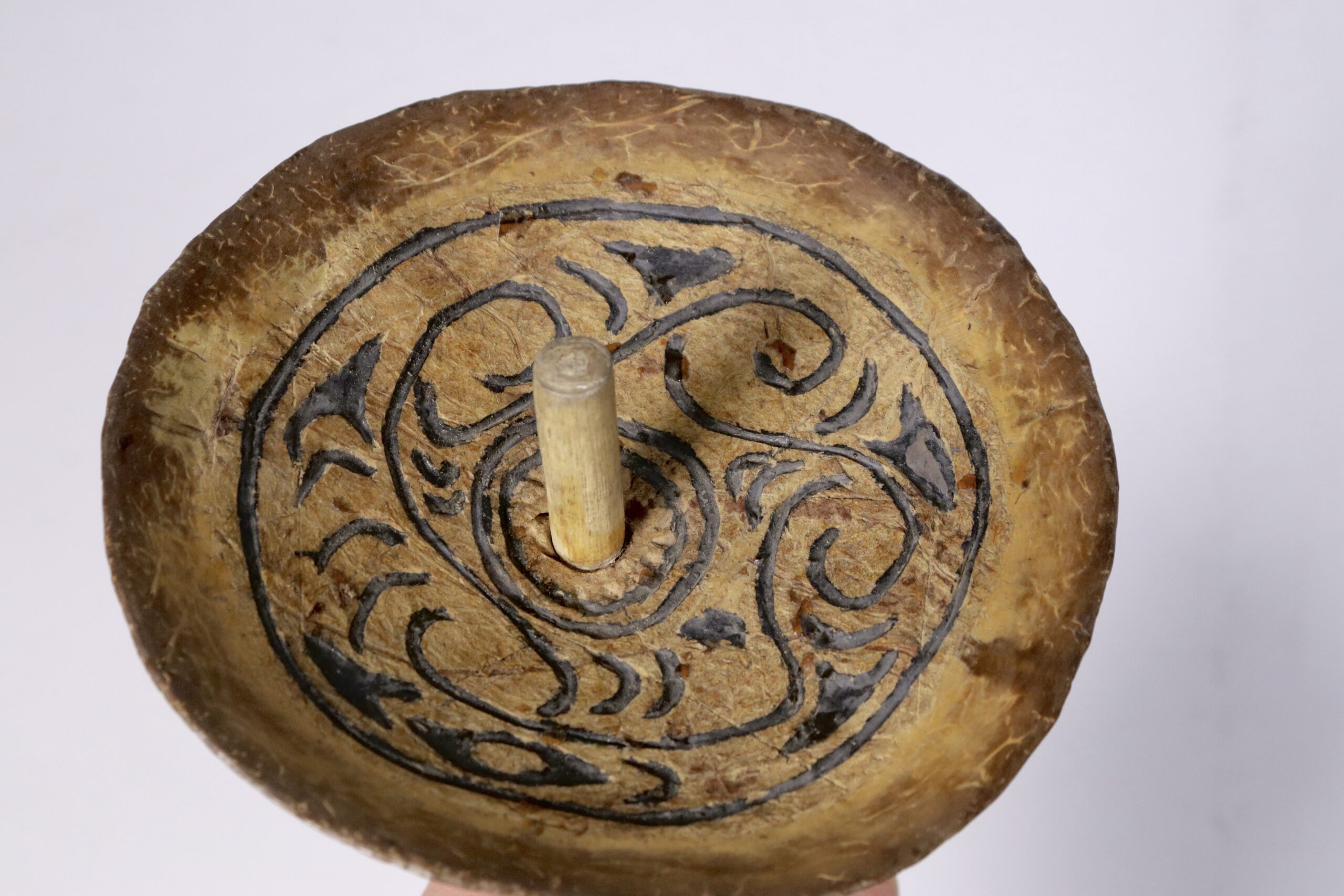
    Doing province research on the Spinning Top Coconut Toy reminded me of what originally drew me to both Anthropology and museums. Growing up visiting the Pitt Rivers, the toy section was always by far my favourite. Staring at these objects, I felt a deep shared connection – a moment of realization that despite the vastness of the world, our shared humanity unites us all. We all have an innate desire to play and connect with others, to gather over a meal, to dress up and dance.

    Particularly amidst the political and global chaos that has ensued throughout the timeline of this project, this realisation has equally affirmed my belief that we need anthropological collections now more than ever. Even despite their futility and shortcomings, these objects remind us of what unites us all. Now the challenge remains, to create these spaces as places of shared connection and conversation, rather than rebuilding colonial barriers which seek to oppress and divide. 

  • Astrid’s Reflection

    As a child growing up in London, I had the privilege of visiting the various museums and collections available to the public, with the British Museum offering a popular option for a school trip. My experience of wandering through exhibitions and displays is something that sparked my interest in anthropology and material culture, however, now as an anthropology student, I am well aware of these institutions’ colonial legacy and their role in past and ongoing violence. I have also been taught to consider my positionality, meaning it has become critical for me to reflect on my perspective as a museum spectator, encouraging me to ask: what is my role in reimagining museums and collections?  

    When I was thinking about this question, I remembered two exhibitions: Fred Wilson’s Mining the Museum (1992-1993) in The Maryland Historical Society and the recent intervention in the British Museum, what have we here? (2024-2025) by Hew Locke. The starkness, irony and sheer horror of Wilson’s exposé, including a baby carriage containing a Ku Klux Klan hood and slave shackles positioned alongside silverware, made it a revolutionary exhibition within both the art world and museum culture. Now thirty-two years later, Hew Locke’s excavation of one of the most infamous museums in the world implicitly invites us to demand what, exactly, has changed since Mining the Museum opened in 1992?  

    As Locke deliberately uses the words loot and looting to uncover the journeys of various objects that have been erased by the institution, we can see there is a long way to go before museums fully address their active participation in imperialism and their continued reproduction of colonial violence. What struck me the most were the colourful figures of The Watchers that become part of the museum, hovering in corners and lurking behind curtains. As they point and silently observe, The Watchers call on the museum visitors to address their internalized complicity as they walk through the exhibition. Under their judging eye, the spectators become an exhibit, their unconscious bias and cognitive dissonance making them a part of the structure of the museum and its ongoing brutality.  

    By making his visitors culpable, Locke illuminates the complicity of the museum spectator. The tendency for museum visitors to don a gaze that is unquestioning, exclusionary, essentializing and comfortable, demonstrates our need for introspection when we walk through these exhibitions. While conversations about decolonising museums are often centred around curatorial and institutional change, this shows that only by approaching our personal discomfort can the museum and the spectator work together to cast off the language of empire we have received via museums.  

    Despite the need to question both ourselves and our institutions, Locke’s aim is not for the exhibition to be a ‘miserable show’. When Locke displays objects that have been scorched and damaged as they were looted, he doesn’t shy away from exposing their “messy” and violent histories. Yet, though his exhibition is designed to shock, he also intends to create a space for long overdue dialogue. It is through eliciting uncomfortable conversations and unsettling our preconceptions that I believe museums and collections can retain their value. By reimagining them as sites for learning about our colonial past and thinking about how we are implicated in this history, there could be a way to still incite that curiosity about different cultures and peoples that I had as a child. After all, the success that Mining the Muesum had in communicating the violence of empire, and the entrenched nature of slavery and racism to the public, is testament to the impact that collections and museums can have, when they are re-conceived to unsettle the status quo and oppressive structures of power.  

  • Beyond Visuality and into an ESP framework  

    Beyond Visuality and into an ESP framework  

    by Ariela Silber  

    Christina Hodge’s interdisciplinary ‘Experiential Observation + Synesthetic Analysis + Polysemous Interpretation’ (ESP) framework integrates visual analysis and multisensory observation with anthropological insights. It seeks to enhance understanding of material culture while promoting decolonization in anthropological practices through distortion and reflection of the western gaze. This contends with material culture study and moves beyond museum objects, as props exhibited to illustrate stories written by placards but instead produces a framework that allows a cultural competency, reflexivity, grounded within cultural relativism. In placing art under the focus of anthropology, a disruption of the “curational gaze” (Hodge 2018: 143) is established, where human subjectivity and meaning is emphasised in comparison to judgement based on an objects’ formal qualities which risk self-referential connoisseurship that detaches objects from their cultural and political contexts. Hodge’s ESP framework carefully acknowledges and mitigates the pervasiveness of the distanced gaze and ocularcentrism by incorporating multisensory experiential analysis at the forefront.  

    The project work we undertook with the Social Anthropology Teaching Collection is enmeshed with the colonial domination that Anthropologists in our institution propagated. When first establishing provenance work, research and creative outputs, a necessity to be in proximity with the objects was forefront. Our aim of emulating and adapting Hodge’s framework guided our ways of knowing beyond the visuality, with the co-presences of ourselves and our objects reaching all senses. Our thoughts, ideas and designs seen in our website, zine and catalogue are encouraged to challenge and destabilise the established inequalities which brought these objects into our custodianship, aiming for personal and institutional reflexivity, grounded within relativism. We usher active engagement from readers, academics and publics about our curatorial choices but go in knowingly that our position is representing an institution which remains embedded in facilitating its colonial pasts and presents. 

    Ariela Silber  

    References:  

    Hodge, C. J. (2018). Decolonizing Collections‐Based Learning: Experiential Observation as an Interdisciplinary Framework for Object Study. Museum Anthropology, 41(2), 142–158 

This website uses Google Analytics to gather usage statistics. Please accept or reject.

Cookie preferences